I got this down off the shelf because it’s relevant to one of the things I’m working on, and because – some 39 years after buying it and reading it for the first time – I feel like I’m finally in a position to understand and make use of it. Follow along with me, as I do a reasonably close reading of it here? It ought to be a fair amount of fun. #nomadology #deleuzeandguattari #deleuze #guattari
Post
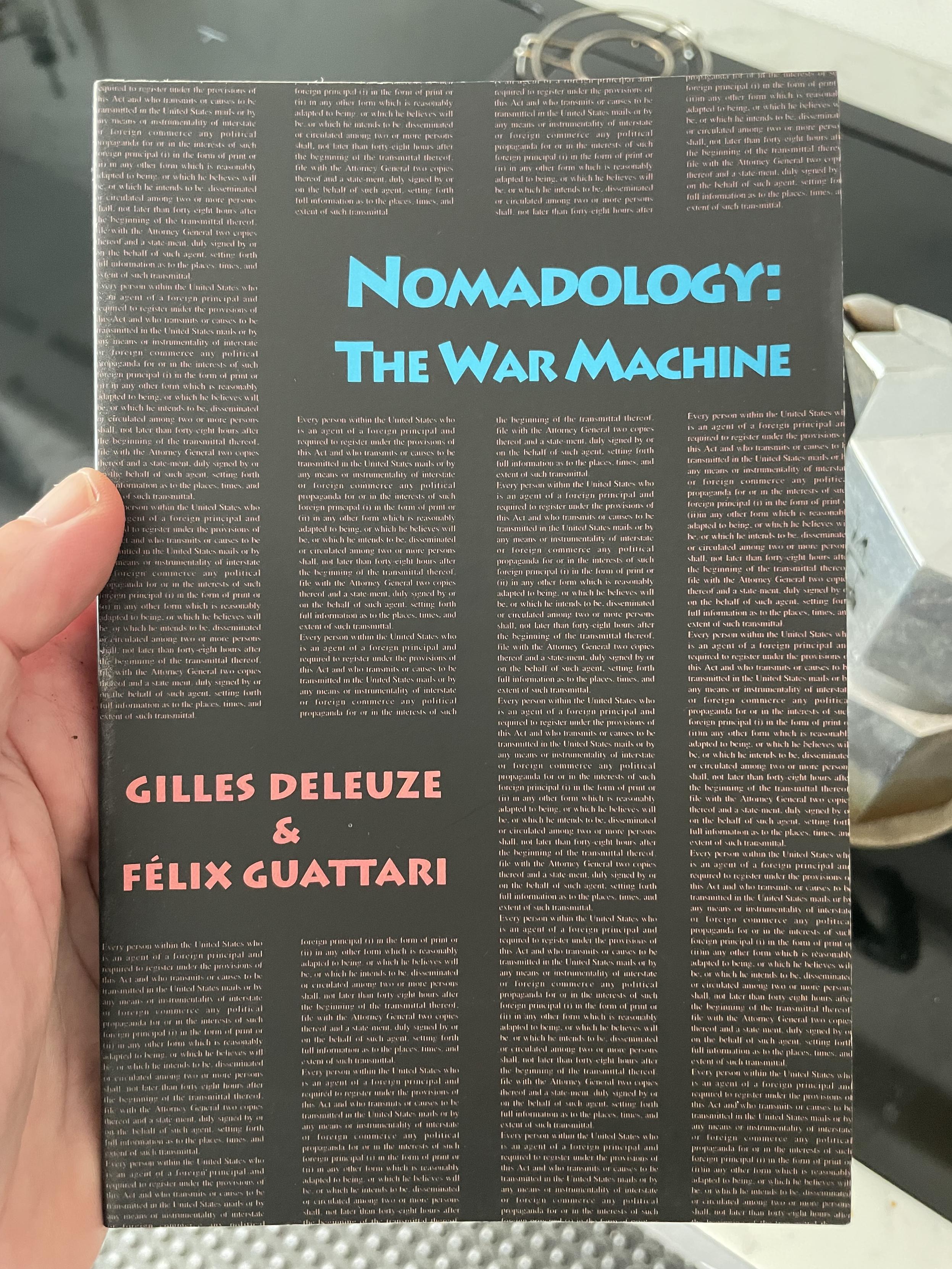
A couple of prefatory notes, by way of housekeeping: “Nomadology” is a chapter (or “plateau”) from “A Thousand Plateaus,” but I’ll be reading it as though it were a standalone offering; being equipped with only enough French to know when the subtitles on a film are terrible, I am necessarily reading translator Massumi’s “Nomadology”; and I don’t know what depth I’ll get into in posts or what kind of schedule I’ll be able to keep. Assume a reader with a magpie mind & little scholarly inclination.
So let’s get into it!
There’s very little in the way of front matter, only a sideways acknowledgment that this is an extract from a longer work, and no introduction to speak of. The very first lines that greet the reader are these:
“Axiom 1: The war machine is exterior to the State apparatus.
Proposition 1: This exteriority is first attested to in mythology, epic, drama and games.”
This is what’s known as “throwing the reader in at the deep end” (triply so if that reader is 17, self-taught but otherwise a product of American schooling, and struggling with what we’d now call “ADHD”). What could any of this possibly mean?
It’d be decades before anyone taught me to read for the text’s implicit ontology and epistemology, but we can already kinda see what the big chunky objects in play here are: the “State apparatus” – which I already had an instinctual anarchist’s antipathy for – and “the war machine,” which I was just about quick enough to realize they meant in something other than the literal, Black Sabbath “War Pigs” sense. And the latter occupied a relationship of exteriority to the former: it remained outside.
The word “apparatus,” then, wouldn’t have had any particular resonance for me; I just took it to mean something like “machinery.” So we’re starting with the idea that there’s something called a war machine, more metaphorical than literal, and it’s being opposed to something you might naturally assume was its proper home: the State, something I already associated w/hierarchy, structure & command. And we’re told that this relationship is first made manifest in “mythology, epic, drama and games.”
As for the stress placed on that “exteriority,” the only resonances that came to my mind naturally enough had to do with being an outsider – a loner, a weirdo, a nonconformist. In 1986: a punk. And that struck a chord: per the title, I already knew not merely that the book had something to do with nomads, but that this nomadology was linked to the figure of the war machine. A picture is already beginning to form, however kaleidoscopically.
How about “mythology, epic, drama and games,” though? My background here, like most Americans, was not strong, though I’d enjoyed the sort of middle-class privilege that involves kids being herded through the museum to consider paintings of Prometheus having his liver pecked out. And even that meager foundation dropped away like an elevator with a snapped cable when I hit the book’s very first full sentence. Here it is:
“Georges Dumézil, in his definitive analyses of Indo-European mythology…
has shown that political sovereignty, or domination, has two heads: the magician-king and the jurist-priest.” Oof!
You’ve got to imagine that there was no internet. The search engine wouldn’t be invented for another decade or so. I suppose I could have gone to the NYU library and looked up Dumézil – that’s certainly what my more diligent friend Jamie would have done, probably before proceeding to the next sentence – but it’s 1:30AM on 7th & B. You’re just going to have to get on with it.
We can, I think, safely assume that D&G do not *primarily* mean to invoke Foucault’s notions about “sovereignty” and “discipline” here, though surely that progression was hovering in the background for them in a way that it wasn’t for me. Let’s take them to mean sovereignty in its less specialized sense, just as they gloss it: a relationship of domination. Right here, in this first sentence, they’re invoking the comparative linguist & mythologist Dumézil to *differentiate forms of domination*.
But maybe “forms” isn’t quite it? Maybe it’s closer to *modes*. And Dumézil tells us that from the infancy of what would become the West, myth, legend and (where these things are distinguishable from) history agree that there are two distinct and recognizable modes in which domination is enacted over people: “Rex and flamen, raj and Brahman, Romulus and Numa, Varuna and Mitra, the despot and the legislator, the binder and the organizer.” Thank god for those last two opposed pairs!
[Dinner break! And a chance to let all that settle.]
Some links before we proceed! It is, after all, very much in the D&G spirit to pursue tendrils sideways through the loam:
Georges Dumézil: https://en.m.wikipedia.org/wiki/Georges_Dum%C3%A9zil
Here’s a bit on the differing rationalities of power Foucault distinguishes as “sovereignty” and “discipline”: https://criticallegalthinking.com/2024/08/27/foucault-power/
…and some thinking about some of the resonances that may crop up when D&G refer to a “State apparatus”: https://openreadings.wordpress.com/2014/08/23/apparatus-dispositif-material-discursive-practice/
(At suitable intervals, I’ll drop in links to topics that crop up in the text, neither assuming that you’re already comprehensively familiar with this material, nor that it’s utterly new to you.)
OK, we go on! And I promise we’re not going to be quite as painstaking as we move on, but I think it’s important to lay out each element in the array of opposed pairs D&G offer to characterize Dumézil’s two modes of domination.
“Rex and flamen”: These are roles in the ceremonial culture of Rome, different channels by way of which divinely-sanctioned authority flowed through the Roman state.
Wikipedia (sorry) tells us that the “rex sacrorum (‘king of the sacred things’)” was a “senatorial priesthood” (!) reserved for patricians, while the flamen were high-ranking members of society who officiated the cults of various gods.
Hmm, I kind of get it? But to someone whose education has not immersed them in the culture of ancient Rome, there isn’t really enough contrast here to quite grasp the distinction D&G are trying to make. Perhaps we’ll have better luck with…