

OK. Later today I'm going to write about a neat little equality. Here it is. On the left you have the Riemann Zeta function, on the right, a product (that's what the big blocky pi symbol means) with primes in every term.
That these are equal is really neat. And you don't need calculus to see this.
Here is the problem. The sum on the left lets n be every natural number, but on the right you just have p and it's just primes. How did it happen?
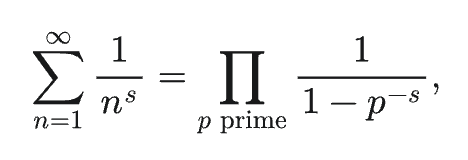

You look at an equation like that one and you know some serious math is going down.
But, the way it works is so ... friendly. It uses a fact you probably learned in high school and have maybe forgotten, so I suppose as a high school math teacher it's vindicating to see that a tired old theorem still gets to be the star.
I'm talking about the fact that every natural number has a unique prime factorization.
There is only one way to factor 275* for example.
*or any number