The Maris Review, vol 119
The theme of the week is who has a soul and who is a mere husk of a person (the answer might surprise you)
What I read this week
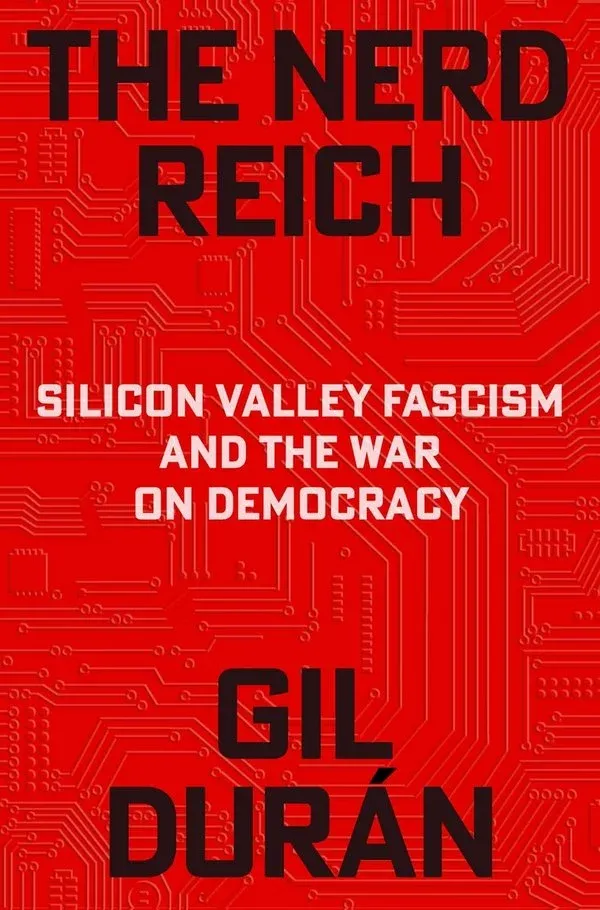
The Nerd Reich: Silicon Valley Fascism and the War on Democracy by Gil Durán
In the 80s and 90s pop culture told us time and again that the frat presidents and the guys on the football team were the ones who would rule the world. I want to say that off the top because I wonder if younger people know that in the not so distant past that nerds were, for the most part, considered harmless or misunderstood, even nice, or good. Yes, there were always evil geniuses but for the most part the nerd was the a la Ducky in Pretty in Pink.
In the early aughts we got Seth Cohen and other indie rock and comic book enthusiasts who were actually hot. The era of the hot nerd was short-lived, a flash in the pan as far as the wider culture is concerned. This was also the time when we (or, at least, I) thought internet startups were noble endeavors that were going to save the world.
All this to say that I was not prepared for nerds to become the most dangerous and deranged misanthropes of our time, threats to our safety and our democracy. Nerds used to love things – theater, comedy, books, etc – too much, and now they just hate things, including art, most people, and democracy.
Gil Durán's excellent, terrifying, and infuriating new book outlines how Silicon Valley became fascist (Malcolm Harris gives a pre-tech but still fascist history of the area in Palo Alto, which Durán cites), and how a few weasel-y, boorish, soulless tech bros were able to amass so much power. This is all stuff I kind of knew, from the glee that tech billionaires take in prepping for a time when the world ends but they still have their super cool bunkers, to the tech class's disdain for anything or anyone that isn't optimizing at all times (they still think they are saving the world).
But when the information is all in one place the portrait of our ruling class is damning: Peter Thiel, Elon, Marc Andreessen, and Balaji Srinivasan don't simply want to become the richest and most powerful people on the planet – they also very much want to destroy things. Duran takes us through their ways of thinking and the books (and internet trolls turned billionaire whisperers like Curtis Yarvin!) who influenced them. There are many different "isms" in play, but of course they don't add up to a coherent philosophy. Together they envision a world in which the non-tech people become subservient to the tech class. The tech people partner with the conservatives to eliminate as many progressives as possible. CEOs rather than governments rule countries. Humans will populate Mars and/or floating barges in the ocean. Crypto will set us free.
These are the odious ramblings of losers that I wish we could dismiss, but now these losers rule the world, rule us. Tech won't save us, but it might destroy us.
But there is hope: we can fight back by opposing the building of data centers, fighting the usage of LLMs and other AI, shopping local, and making fun of the billionaires, whose egos are very delicate and fragile. We can also call out supposedly liberal politicians who not only put up with this shit, but support it. The Nerd Reich has, at least, invigorated me for the fight.
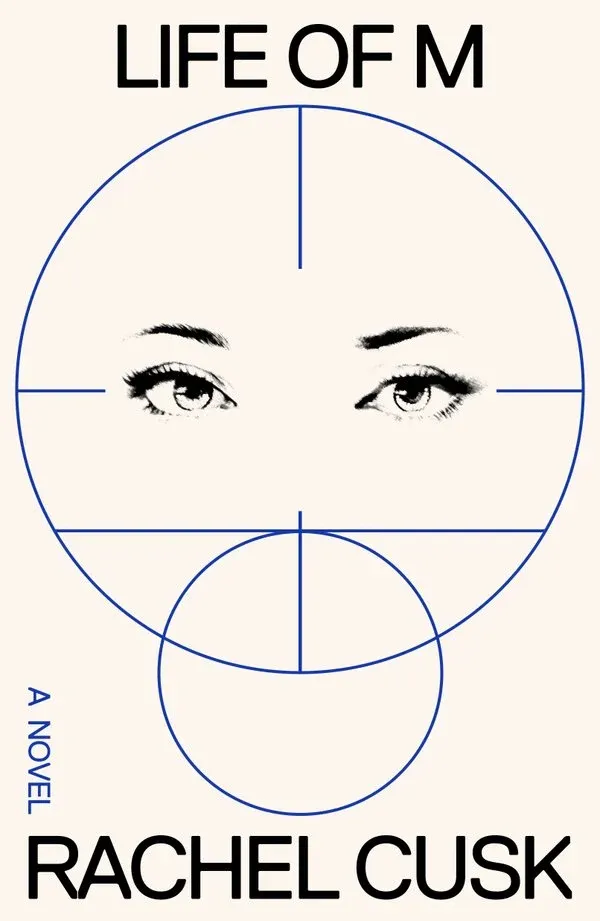
Life of M by Rachel Cusk
Rachel Cusk has done it! She has figured out a way to make a general audience care about literary fiction. If only for that she deserves her flowers.
Now is the book good? It is certainly not my favorite of hers, nor my fourth or fifth favorite. But it's still Rachel Cusk, and she is still better at writing than most. If Life of M feels less like a fully realized novel than a character study of a person who encounters absolutely no conflict or character development, then that's likely the point. Rachel Cusk dispensed with plot in her Outline trilogy (which I loved) and here she turns into the concept of character into a theoretical exercise. Sounds boring, right? It is, kinda.
The premise: a writer (and this is autofiction of course, so we are primed to assume the character is Cusk herself) tells M, an A-list actress who likes books, that she wants to write about her. Much of the novel consists of this "autobiography," a portrait of a woman who is cold and empty inside. There is a lot of description of decor in lieu of character development, which worked beautifully in Vincenzo Latronico's Perfection but here doesn't add up to much.
But then there's the Natalie Portman of it all. The amount of coverage this book is receiving is very much tied to the assumptions we make about writers and their subjects. And if Cusk engineered this, then her experiment with character becomes more of a study of what we, the readers, want to believe about fiction.
SPOILER ALERT: Stop reading here if you don't want to know what happens at the end of Life of M.
Still here? I really did appreciate the book more after reading the final few pages of the novel when the writer and their subject converse. I don't know whether or not this is supposed to be a conversation between Rachel and Natalie, and whether Natalie is mad at the novelist's brutal portrayal of her. But the ending begs the question: why do we need a real person's face and name to match the very vague character who appears in a novel?
I really wrote a screed last week
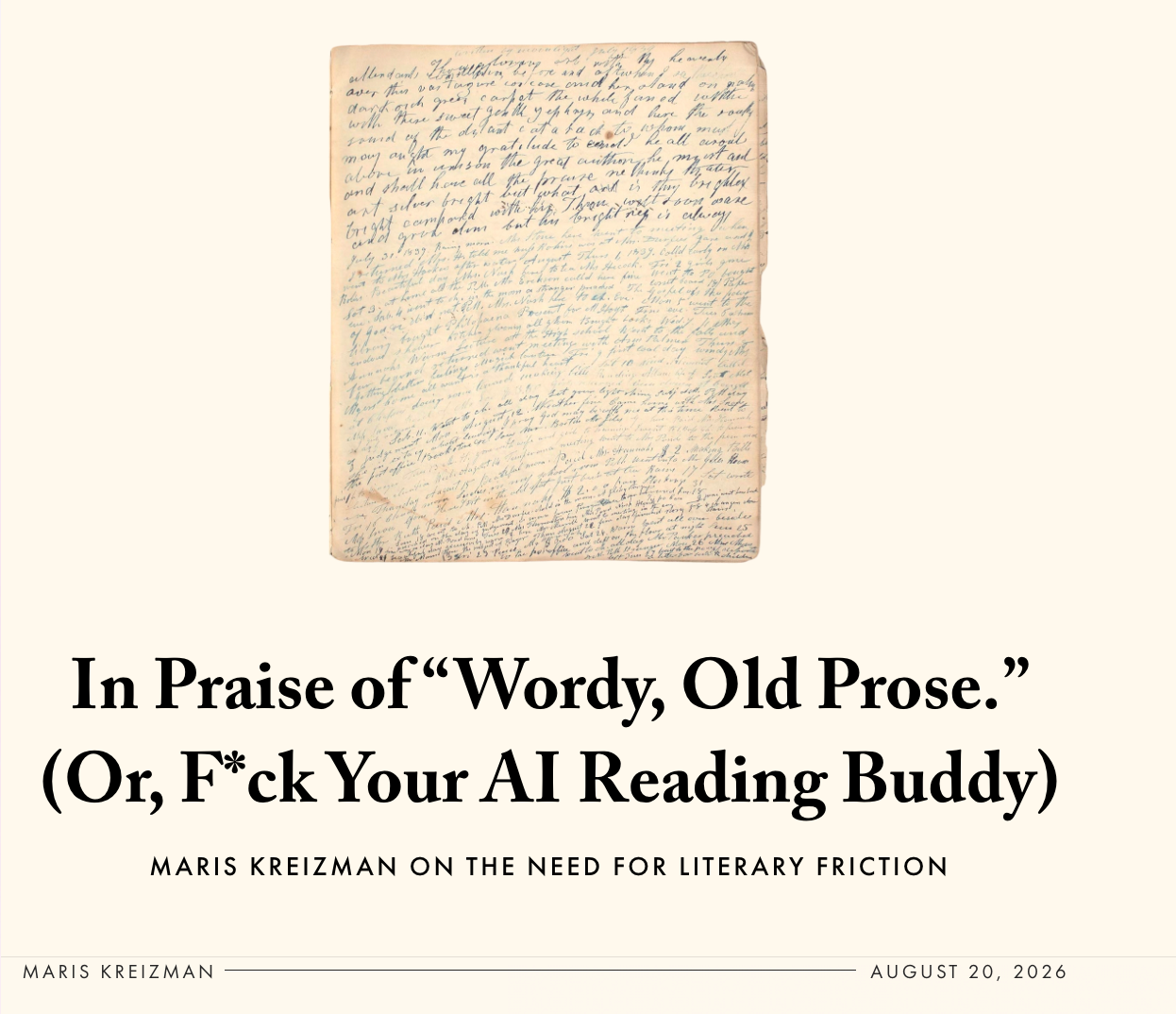
Thank you to Josh for coming up with the term "literary friction" to describe provocative reading unsullied by AI. I wrote about the kind of writing that makes you think, that provokes you, that might even cause discomfort, and how it's being devalued at alarming rates in schools and in our culture in general. The fascists (see above!!) want us to stop thinking and growing and learning – let's not give them what they want!
New releases, 8/25
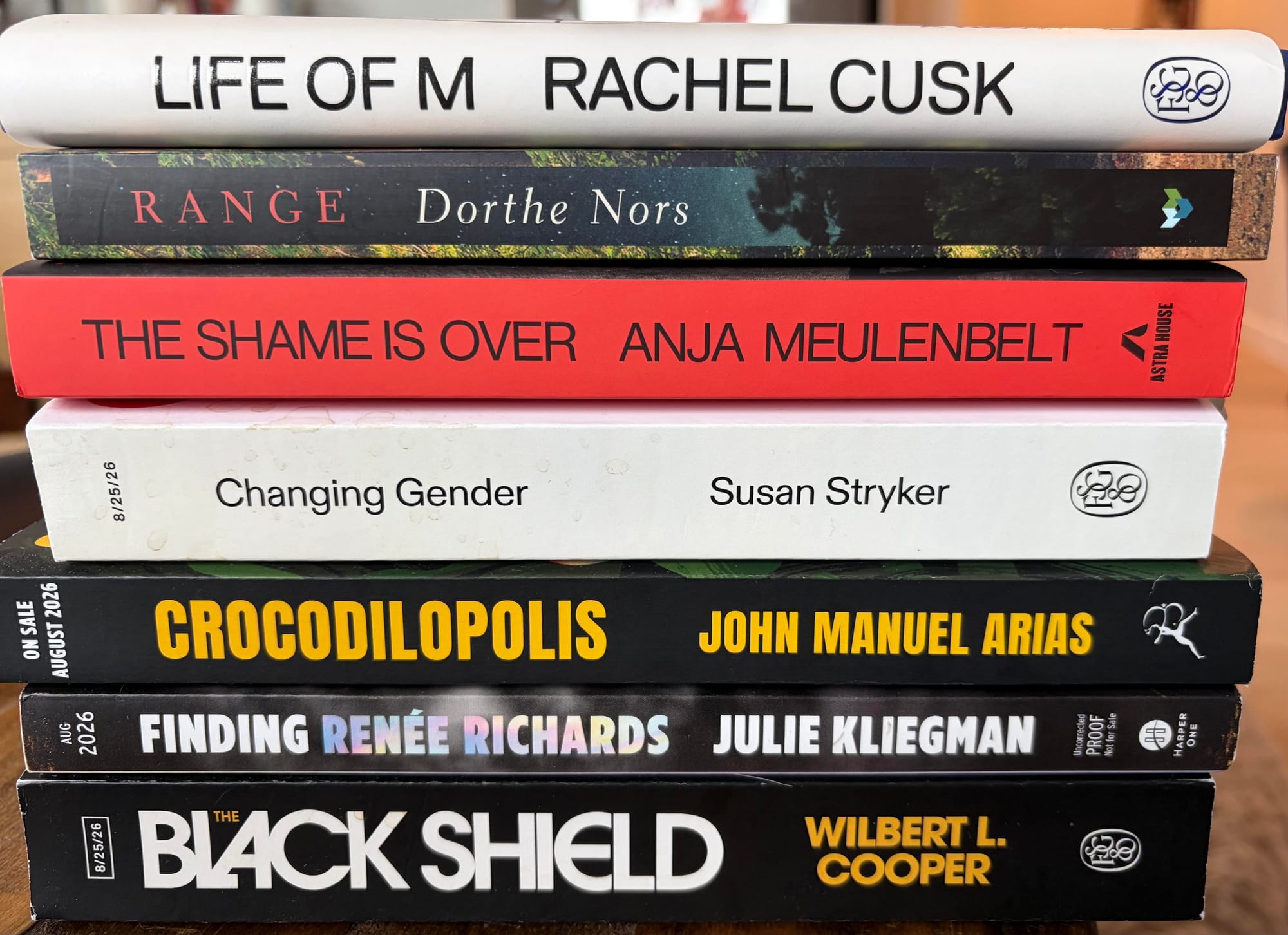
Life of M by Rachel Cusk
Range by Dorthe Nors, translated by Caroline Waight
The Shame Is Over: A Personal History by Anja Meulenbelt, translated by Ann Oostheizen
Changing Gender by Susan Stryker
Crocodilopilis by John Manuel Arias
Finding Renee Richards: The Groundbreaking Story of Tennis’s Trans Pioneer by Julie Kliegman (I think I missed this when it was published last week and wanted to highlight!)
The Black Shield: An American Memoir of Family and Power by Wilbert L. Cooper
Seasons of Fury: Four Families and the Rise of Islamophobia in America by Rozina Ali
Dèy by Edwidge Danticat
The Rise and Fall of the Artificial State by Jill Lepore
Jacaranda by Gaël Faye, translated by Sarah Ardizzone
Ghost Cities by Siang Lu