

@shaunmurdock@mastodon.social @ecosentido @shaunmurdock maybe "reproducing the social relations"?
Discussion
Loading...

@Matt_Noyes @luisrazeto @disco_coop @shaunmurdock @Stacco @emi I am also curious about why do you make a distinction between livelihood work compensation and care work compensation 🤔
@ecosentido @luisrazeto @disco_coop @shaunmurdock @Stacco @emi Hi Joel, sorry not to reply earlier. So, the idea is to divide allocated surplus into three buckets: Livelihood, Care, and Love. E.g. 50%, 30% 20%. Then to distribute each on a pro rata basis per hours worked. That way, if we all start doing a lot of Care or Love work, it won't drain all the resources from Livelihood (which is the work that generates revenue).
Razeto's approach is different, C Factor compensation is not distributed.
@ecosentido @luisrazeto @disco_coop @shaunmurdock @Stacco @emi
So my first question is what do we gain/lose by transposing Razeto's framework for surplus allocation to the DisCO framework?
My second question is what do we gain/lose by treating "management" as part of Care work, that is, as an element of C Factor, when allocating surplus?
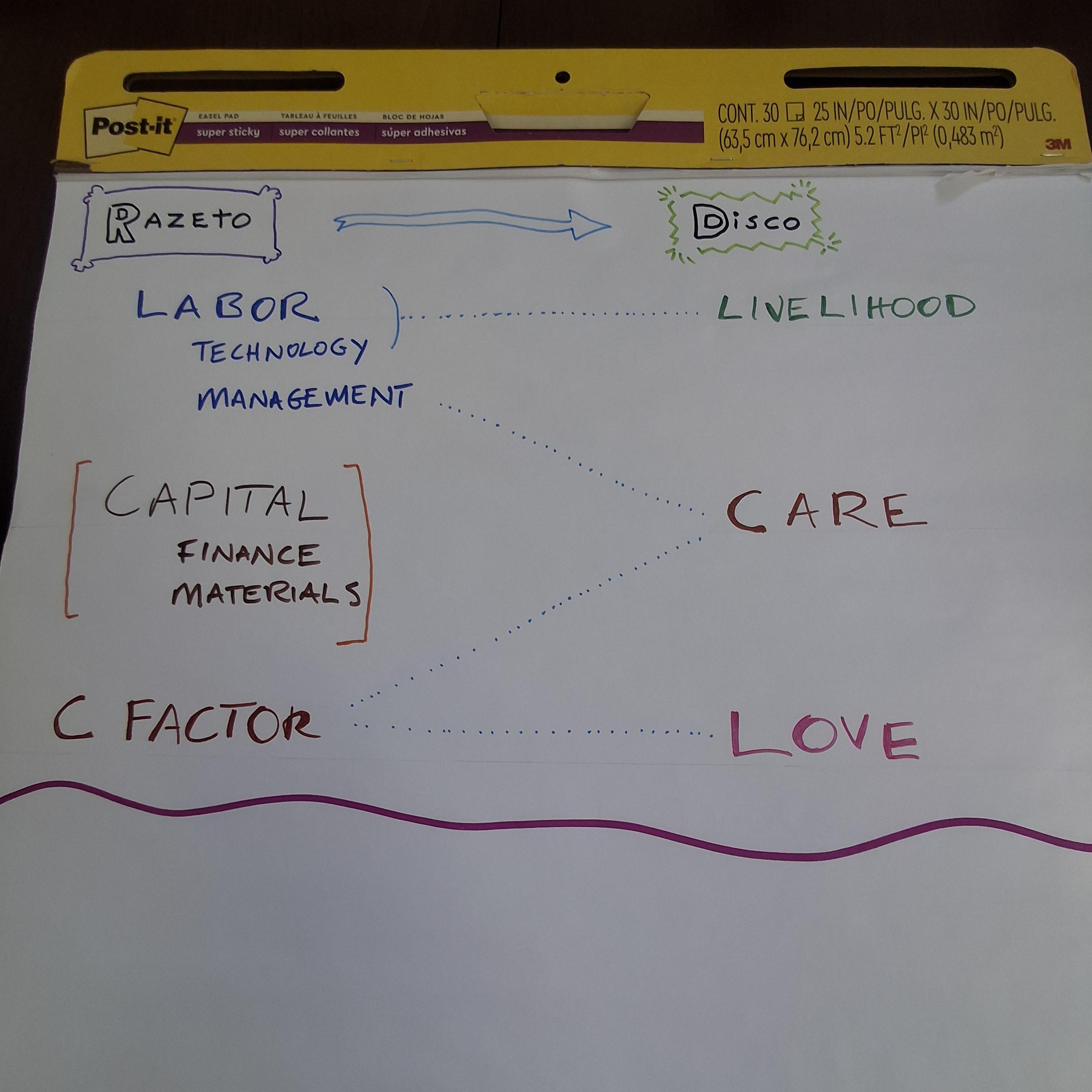
Razeto's framework:
Labor (labor + technology + management)
Capital (finance + material means of production -- all internal, contributed by members)
C Factor (only C Factor, held inn common by group, not allocated to individual members -- [so not really allocated?])
Transposed to DisCO framework:
Livelihood (labor + technology)
[no allocation for member contributions of finance and materials]
Care (C Factor + Management)
Love (C Factor for non-members, e.g. pro bono work for social movement groups or a local river)
@ecosentido @luisrazeto @disco_coop @shaunmurdock @Stacco @emi
Note:
Technology here means skill, knowledge, technical capacity applied in the labor process, not machinery or other embodied knowledge. It is typically reflected in higher compensation.
Management means administration, planning, coordination, negotiation, decision-making, evaluation, etc. Also typically reflected in higher compensation.
Capital is only internal capital, that is, capital obtained through member contributions, not through borrowing or buying from external sources. In Razeto, this is compensated through labor shares.
@luisrazeto @disco_coop @shaunmurdock @Stacco @emi Ok @Matt_Noyes I am ready to answer your Q
According to Razeto, solidarity enterprises use Labor & C Factor as the main Category, so all factors become “people”:
Labor = people who do
Tech = people who know
Mngmt = people who decide
Finance = people who trust
Materials = people who own
C factor = people who unite
Through that lens, management can be compensated as Care Work unless you make a distinction…
@luisrazeto @disco_coop @shaunmurdock @Stacco @emi @Matt_Noyes The management factor can be compensated as Care Work unless you make a distinction of administrative (policy, governance) and operating (day to day) decisions, then “administrative management” can be Care Work and “operational management” can be Livelihood Work.
Does it make sense?
2+ more replies (not shown)

@Matt_Noyes @luisrazeto @disco_coop @shaunmurdock @ecosentido @Stacco @emi I think the latter---so-called "management" as collective care. I like how the DisCO framework recognizes that this happens within a core set of trustful relationships
@arod @luisrazeto @disco_coop @shaunmurdock @ecosentido @Stacco @emi Thanks. That's my inclination, too, but I want to careful when blending categories from two different frameworks.