Discussion
Loading...

Discussion

Log in
  • About
  • Code of conduct
  • Privacy
  • Users
  • Instances
  • About Bonfire
Corey S Powell
Corey S Powell
@coreyspowell@mastodon.social  ·  activity timestamp 5 days ago

In happier news, it's been a great week for learning strange new things about the universe. A few highlights:

The Rubin Observatory opened its eyes & immediately discovered 1900 asteroids, including the fastest-spinning large asteroid (once every 1.88 minutes!).

https://noirlab.edu/public/news/noirlab2601/ #science #nature #space

The lightcurve of 2025 MN45 — the fastest-rotating asteroid with a diameter over 500 meters that scientists have ever found. The y-axis shows the asteroid’s brightness, and the x-axis shows its phase, or where it is in its rotation. When plotted, the resulting curve shows the asteroid's fluctuating brightness as it spins. Lightcurves can help scientists determine an asteroid's rotation period (the total time it takes to complete one rotation), size, shape, and surface properties.

The discovery of 2025 MN45 was made using data from NSF–DOE Vera C. Rubin Observatory, jointly funded by the U.S. National Science Foundation and the U.S. Department of Energy's Office of Science. The asteroid is about 710 meters (0.44 miles) in diameter, and it completes a full rotation every 1.88 minutes.

The lightcurve of 2025 MN45 — the fastest-rotating asteroid with a diameter over 500 meters that scientists have ever found. The y-axis shows the asteroid’s brightness, and the x-axis shows its phase, or where it is in its rotation. When plotted, the resulting curve shows the asteroid's fluctuating brightness as it spins. Lightcurves can help scientists determine an asteroid's rotation period (the total time it takes to complete one rotation), size, shape, and surface properties. The discovery of 2025 MN45 was made using data from NSF–DOE Vera C. Rubin Observatory, jointly funded by the U.S. National Science Foundation and the U.S. Department of Energy's Office of Science. The asteroid is about 710 meters (0.44 miles) in diameter, and it completes a full rotation every 1.88 minutes.
www.noirlab.edu

NSF–DOE Vera C. Rubin Observatory Spots Record-Breaking Asteroid in Pre-Survey Observations - First peer-reviewed paper using LSST Camera data identifies an asteroid, nearly the size of eight football fields, rotating every two minutes

Astronomers analyzing data from NSF–DOE Vera C. Rubin Observatory, jointly funded by the U.S. National Science Foundation and the U.S. Department of Energy's Office of Science, have discovered the fastest-ever spinning asteroid with a diameter over half a kilometer — a feat uniquely enabled by Rubin. The study provides crucial information about asteroid composition and evolution, and demonstrates how Rubin is pushing the boundaries of what we can discover within our own Solar System.
  • Copy link
  • Flag this post
  • Block
Corey S Powell
Corey S Powell
@coreyspowell@mastodon.social replied  ·  activity timestamp 5 days ago

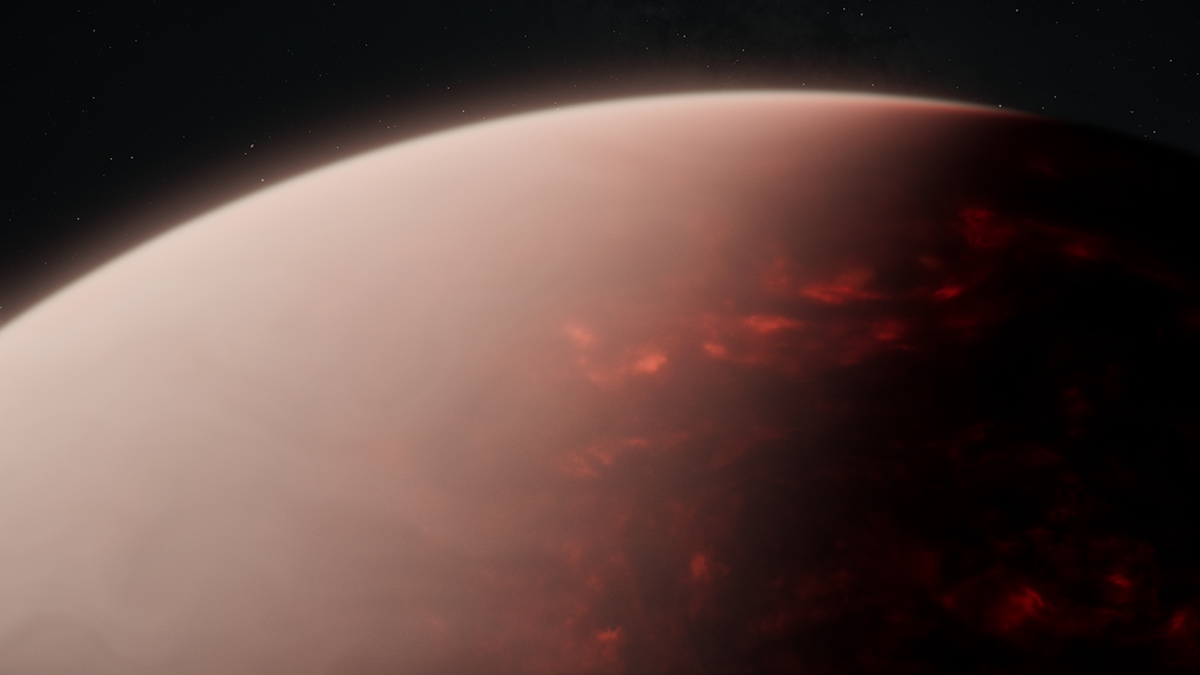
A hellish world: Planet TOI-561 b, slightly larger than Earth, orbits an ancient, sunlike star so closely that a "year" lasts just 11 hours and its surface is lava. Yet somehow it has a thick atmosphere, hinting at how old, battered planets might rejuvenate themselves.

https://eos.org/articles/a-lava-world-unexpectedly-hosts-an-atmosphere #science #nature #astronomy

The seemingly thick atmosphere of exoplanet TOI-561 b, seen here in an artist’s rendition, is most likely composed of material outgassed from its molten surface. Credit: NASA, ESA, CSA, Ralf Crawford (STScI)
Eos

A “Lava World” Unexpectedly Hosts an Atmosphere - Eos

TOI-561 b, an exoplanet roughly 275 light-years away, seems to have a thick atmosphere despite being wildly irradiated by its host star.
  • Copy link
  • Flag this comment
  • Block
Corey S Powell
Corey S Powell
@coreyspowell@mastodon.social replied  ·  activity timestamp 5 days ago

See the little dot? New studies of that blue flash from the distant universe (a "Luminous Fast Blue Optical Transient") indicate it was caused by a black hole swallowing an entire star. For a moment, it blazed as bright as 100 billion Suns.

https://public.nrao.edu/news/radio-telescopes-uncover-invisible-gas-around-record-shattering-cosmic-explosion/ #space #science

A new, extremely luminous fast blue optical transient, AT2024wpp, flares as a bright blue point of light in the left panel, located just off the edge of its faint host galaxy, while the right panel shows the same region of sky after the outburst faded. Credit: Astrophysics Research Institute, Liverpool John Moores University/Daniel Perley
National Radio Astronomy Observatory

Radio telescopes uncover “invisible” gas around record-shattering cosmic explosion - National Radio Astronomy Observatory

Astronomers using the NSF Very Large Array and ALMA have uncovered dense, “invisible” gas surrounding AT2024wpp—the brightest known fast blue optical transient—revealing that a massive star was torn apart and consumed by a black hole.
  • Copy link
  • Flag this comment
  • Block
Vaneshi@bitbang.social
@Vaneshi@bitbang.social replied  ·  activity timestamp 4 days ago

@coreyspowell

TIL: Blue is the colour of "ohh shit!" for stars.

  • Copy link
  • Flag this comment
  • Block
Corey S Powell
Corey S Powell
@coreyspowell@mastodon.social replied  ·  activity timestamp 5 days ago

JWST spotted point-like lights at the edge of the visible universe. Black holes? Nope. Colliding galaxies? Nope. Something never seen before.

These may be primordial clumps of gas collapsing directly into dense clusters of stars--some of the very first galaxies.

https://arxiv.org/abs/2509.12177 #space #science #nature

Four of the nine galaxies in the newly identified “platypus” sample were discovered in NASA’s James Webb Space Telescope’s Cosmic Evolution Early Release Science Survey (CEERS). One key feature that makes them distinct is their point-like appearance, even to a telescope that can capture as much detail as Webb. Image: NASA, ESA, CSA, Steve Finkelstein (UT Austin); Image Processing: Alyssa Pagan (STScI)
arXiv.org

A New Population of Point-like, Narrow-line Objects Revealed by the James Webb Space Telescope

We report a new population of objects discovered using the data from the James Webb Space Telescope, which are characterized by their point-like morphology and narrow permitted emission lines. Our sample includes nine objects found in three JWST wide survey fields, which have z=3.624 to 5.378 and M_B ~ -18.3 to -21.4 mag. Their light distributions follow gaussian profiles, with the full-width-at-half-maximum (FWHM) values only 3.7%--34.6% larger than those of the point spread functions. Their sharpest FWHM sizes correspond to only 0.49 to 0.96 kpc. They have very strong [O III] and Halpha lines (median rest-frame equivalent widths of 1610.6 and 1374.0 A, respectively), and the line widths of the latter are only 150--360 km/s. Due to the limitation of the current data, the exact nature of this new population is still uncertain. The emission line diagnostics shows that at least one object is consistent with being AGN. On the other hand, the spectral energy distributions of most of the nine objects can be fitted reasonably by normal galaxy templates, which suggest that they could also be very young (median age of 120 Myrs), star-forming (median star formation rate of 1.8 Msun/yr) galaxies in the early formation stage (having acquired a median stellar mass of only 10^{8.4} Msun). If they are indeed star-forming galaxies, their gas-phase metallicities range from 12+log(O/H) = 7.8 to 8.3. It will be critical to understand this population by deeper medium-resolution spectroscopy in the future. If they are AGNs, they constitute a new kind of type 2 AGNs that are low-luminosity and almost "hostless". If they are star-forming galaxies, they also constitute a new kind whose early formation is likely a secular process starting from a very compact core, which is in line with the picture of a monolithic collapse.
  • Copy link
  • Flag this comment
  • Block

bonfire.cafe

A space for Bonfire maintainers and contributors to communicate

bonfire.cafe: About · Code of conduct · Privacy · Users · Instances
Bonfire social · 1.0.1-beta.35 no JS en
Automatic federation enabled
Log in
  • Explore
  • About
  • Members
  • Code of Conduct