Discussion
Loading...

Discussion

Log in
  • About
  • Code of conduct
  • Privacy
  • Users
  • Instances
  • About Bonfire
Greg Lloyd
Greg Lloyd
@Roundtrip@federate.social  ·  activity timestamp 2 weeks ago

“The key insight is simple. When you design for what a space affords rather than what it is for, you make room for agency. A stairwell can become circulation, seating, vantage point, or social node. None of that shows up in the tidy architectural models, yet all of it emerges in practice once the building comes to life.”

#architecture #affordances #UX
https://mastodon.social/@mamund/115865439639028623

  • Copy link
  • Flag this post
  • Block
Greg Lloyd
Greg Lloyd
@Roundtrip@federate.social replied  ·  activity timestamp 2 weeks ago

@mamund 🧵Social Software Affordances

Explaining Twitter in 2009 was *much* more fun

"It is a sense of place, not space, which makes it appropriate to dance at a Grateful Dead concert, but not at a Cambridge college high table; to be naked in the bedroom, but not in the street; and to sit at our windows, peering out, rather than at other people's windows, peering in. Place, not space, frames appropriate behaviour."

https://tractionsoftware.com/traction/permalink/Blog1014
#affordances #socialsoftware

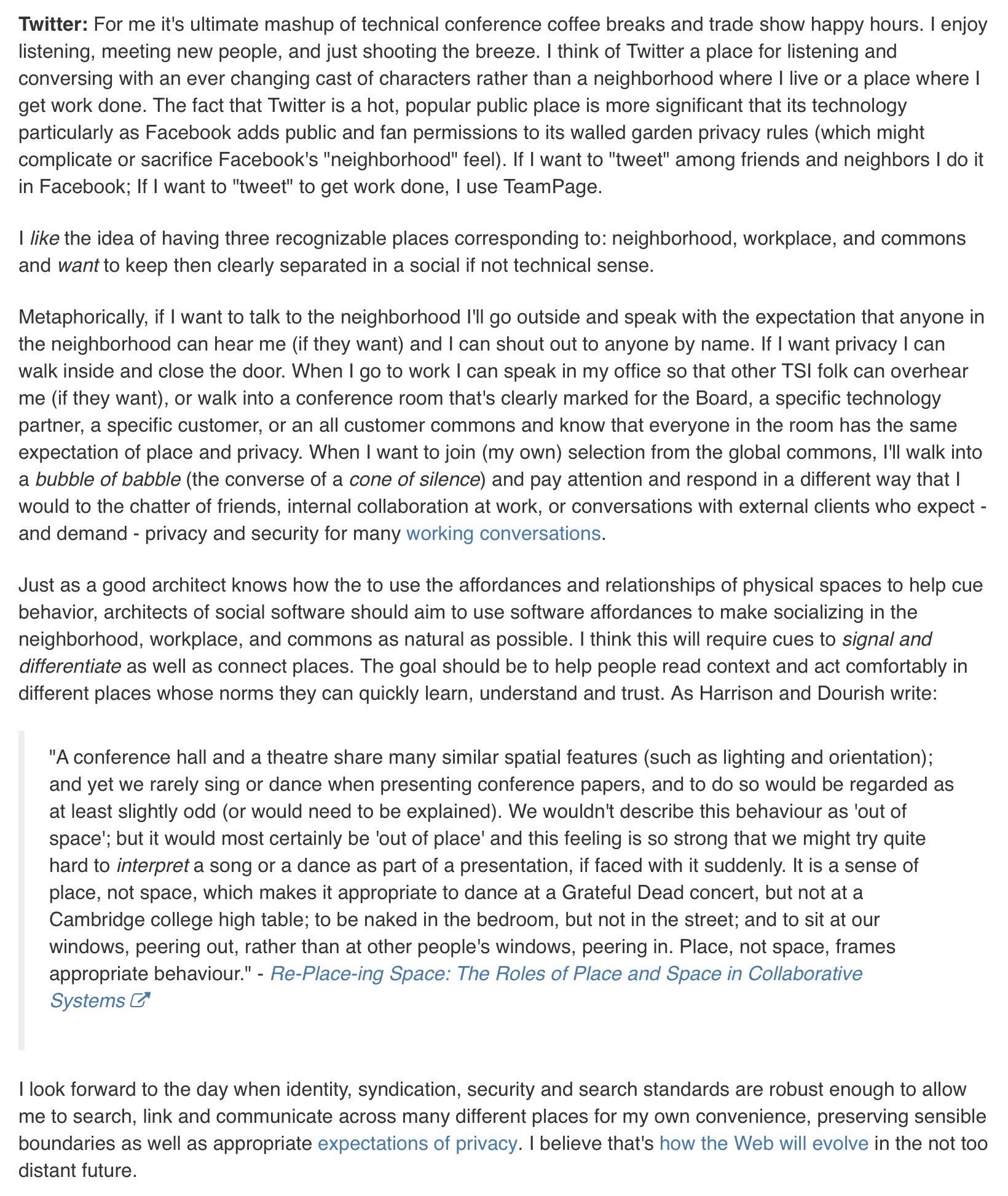
Just as a good architect knows how the to use the affordances and relationships of physical spaces to help cue behavior, architects of social software should aim to use software affordances to make socializing in the neighborhood, workplace, and commons as natural as possible. I think this will require cues to signal and differentiate as well as connect places. The goal should be to help people read context and act comfortably in different places whose norms they can quickly learn, understand and trust. As Harrison and Dourish write:

"A conference hall and a theatre share many similar spatial features (such as lighting and orientation); and yet we rarely sing or dance when presenting conference papers, and to do so would be regarded as at least slightly odd (or would need to be explained). We wouldn't describe this behaviour as 'out of space'; but it would most certainly be 'out of place' and this feeling is so strong that we might try quite hard to interpret a song or a dance as part of a presentation, if faced with it suddenly. It is a sense of place, not space, which makes it appropriate to dance at a Grateful Dead concert, but not at a Cambridge college high table; to be naked in the bedroom, but not in the street; and to sit at our windows, peering out, rather than at other people's windows, peering in. Place, not space, frames appropriate behaviour." —Re-Place-ing Space: The Roles of Place and Space in Collaborative Systems.

Just as a good architect knows how the to use the affordances and relationships of physical spaces to help cue behavior, architects of social software should aim to use software affordances to make socializing in the neighborhood, workplace, and commons as natural as possible. I think this will require cues to signal and differentiate as well as connect places. The goal should be to help people read context and act comfortably in different places whose norms they can quickly learn, understand and trust. As Harrison and Dourish write: "A conference hall and a theatre share many similar spatial features (such as lighting and orientation); and yet we rarely sing or dance when presenting conference papers, and to do so would be regarded as at least slightly odd (or would need to be explained). We wouldn't describe this behaviour as 'out of space'; but it would most certainly be 'out of place' and this feeling is so strong that we might try quite hard to interpret a song or a dance as part of a presentation, if faced with it suddenly. It is a sense of place, not space, which makes it appropriate to dance at a Grateful Dead concert, but not at a Cambridge college high table; to be naked in the bedroom, but not in the street; and to sit at our windows, peering out, rather than at other people's windows, peering in. Place, not space, frames appropriate behaviour." —Re-Place-ing Space: The Roles of Place and Space in Collaborative Systems.
  • Copy link
  • Flag this comment
  • Block
Greg Lloyd
Greg Lloyd
@Roundtrip@federate.social replied  ·  activity timestamp 2 weeks ago

@mamund

“I believe the most interesting point is that Twitter defines a place that escapes the scaling limits of the physical places we're all used to, but invites social creatures like us to build social norms and expectations over the public commons and specific affordances that Twitter created...

I use Facebook, Traction Software's TeamPage server, and Twitter as three separate places: my neighborhood, my workplace, and the public commons I like to use.”

‘Explaining Twitter — 22 Mar 2009’

  • Copy link
  • Flag this comment
  • Block
Greg Lloyd
Greg Lloyd
@Roundtrip@federate.social replied  ·  activity timestamp 2 weeks ago

@mamund

Twitter “…invites social creatures like us to build social norms and expectations over the public commons and specific affordances that Twitter created” Mar 2009

Like the Krell did before they turned off the lights and went to sleep, long ago on Altair IV.

#ForbiddenPlanet #socialsoftware

  • Copy link
  • Flag this comment
  • Block
:mastodon: Mike Amundsen
@mamund@mastodon.social replied  ·  activity timestamp 4 days ago

@Roundtrip

Haha. Just getting to this just Sci-Fi reference. #thanks

  • Copy link
  • Flag this comment
  • Block

bonfire.cafe

A space for Bonfire maintainers and contributors to communicate

bonfire.cafe: About · Code of conduct · Privacy · Users · Instances
Bonfire social · 1.0.1 no JS en
Automatic federation enabled
Log in
  • Explore
  • About
  • Members
  • Code of Conduct