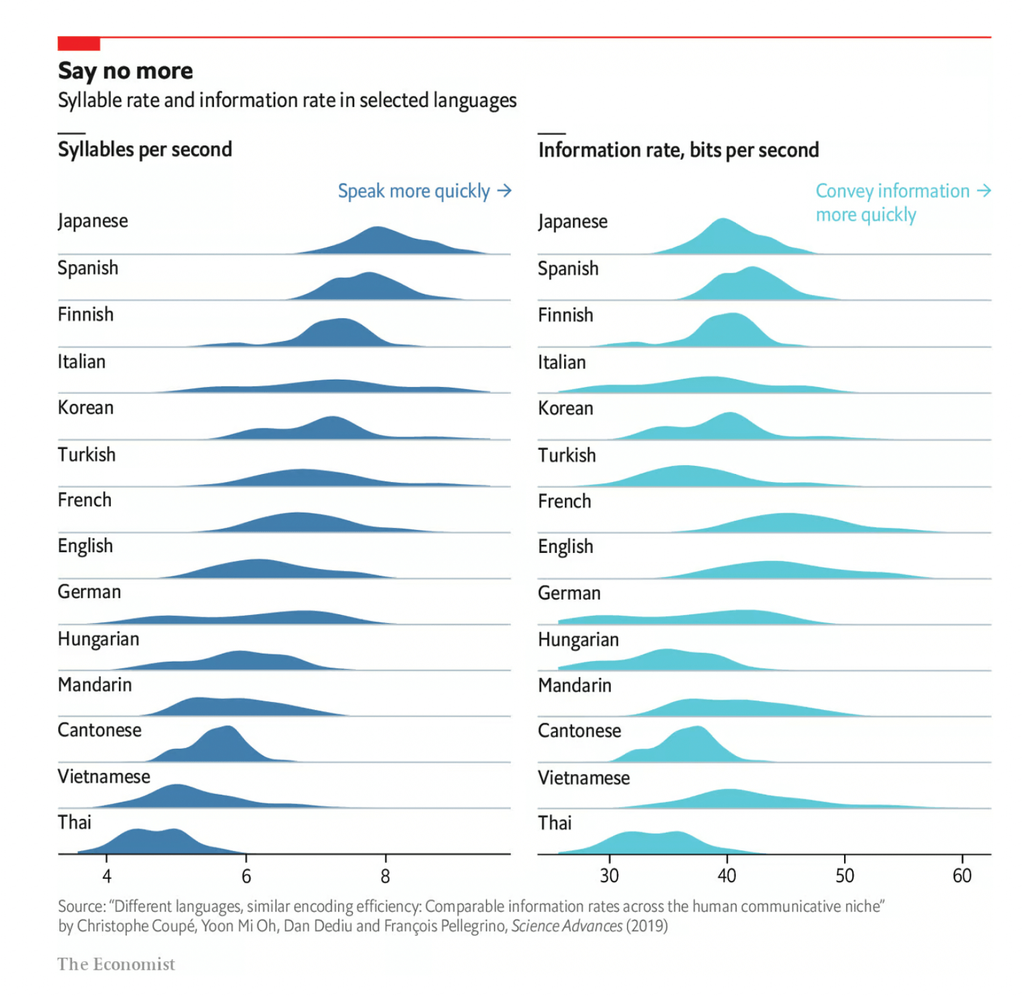

The expressive speed vs information 'bit rate' of spoken languages.
French and Vietnamese have the highest information density.
via The Economist
https://www.economist.com/graphic-detail
Discussion
The expressive speed vs information 'bit rate' of spoken languages.
French and Vietnamese have the highest information density.
via The Economist
https://www.economist.com/graphic-detail
@infobeautiful Vietnamese is so compressed that they often don't understand each other. Some words sound the same, some are actually identical and you have to get the meaning from context. Blue and green are the same word. Three and father are the same word. So yeah, high bitrate, but that might actually be the downside - needs more error correction.
@infobeautiful aaah. The article doesn’t say what the graphic implies.
The article finds that all languages send information at approximately 39 bits per second. The number of syllables is the number of unique syllables allowed per language not syllables per sentence.
“Language is universal, but it has few indisputably universal characteristics, with cross-linguistic variation being the norm. For example, languages differ greatly in the number of syllables they allow, resulting in large variation in the Shannon information per syllable. Nevertheless, all natural languages allow their speakers to efficiently encode and transmit information. We show here, using quantitative methods on a large cross-linguistic corpus of 17 languages, that the coupling between language-level (information per syllable) and speaker-level (speech rate) properties results in languages encoding similar information rates (~39 bits/s) despite wide differences in each property individually: Languages are more similar in information rates than in Shannon information or speech rate. These findings highlight the intimate feedback loops between languages’ structural properties and their speakers’ neurocognition and biology under communicative pressures. Thus, language is the product of a multiscale communicative niche construction process at the intersection of biology, environment, and culture.”
@infobeautiful that seems weird. Thai is very succinct compared to English. Most words are a single syllable and the majority of context is implicit, rather than explicit.
If you try to express something as 1:1 with the English phrase it would be inefficient, but people don’t speak like that.
The English, “let’s get lunch” (e.g. to co workers) would be “ไปกินข้าว“
4syllables in English vs 3 in Thai.
Very complex things are slower in Thai, but the majority of conversations are much faster because they’re sparse and rely on implicit information.
@infobeautiful There's a flaw: it does not contain #tlhInganHol.
#tlh #Klingon
@infobeautiful
Lots of elephants inside of snakes
There is an article cited, but concerned this could possibly be "not even wrong" given its limitations, assumptions and technical model about how information content is defined. (The first author is also French.)
The work is nonetheless valuable and an excellent contribution.
Would be very interested to see results with alternative definitions of information conveyance, particularly from authors more familiar with how symbolic and probabilistic meaning works differently in e.g. Chinese.
@infobeautiful Add to that, in conversations, the French all talk simultaneously. Unbeatable.