

RDV le dimanche 31 mai à 10h30 devant l'incinérateur d'Ivry pour une marche en direction de Vitry. Soyons nombreux et nombreuses pour faire entendre notre opposition à ce projet absurde !

hypebot
boosted


Entwürfe zur Entkriminalisierung des Bahnfahrens ohne Ticket wurden im Bundestag bisher abgelehnt. Aktions-Freifahrer*innen wie Salome Krug und Kjell Winter setzen sich auf eine einfallsreiche Art dagegen ein 👉️ https://taz.de/!6178280/




🚀 💥 Blue Origin's New Glenn makes a crater-sized dent in Artemis plans
「 The New Glenn was expected to launch the company's Blue Moon Mark 1 and Mark 2 lunar landers, with a Mark 1 lander scheduled to deliver NASA's VIPER rover to the Moon in 2027. A variant of the crew-capable Mark 2 lunar lander was also expected to form part of 2027's Artemis III mission. Those plans could face substantial revision or delay 」


@deech @spacehobo IMO the foundational UX issue in programming addressed by LLMs is the modern need in certain settings to blindly make software for software's sake. Much software work now requires programmers to synthesise the abstract concepts of folks systematically making things more complicated than they need to be. BigTech with its massive teams and growth theatre broke things for the common programmer. Lots of other software businesses now service the needs of BigTech. All of that is rotten.


I’d love to do a proper study on this. I find it hard to define the difference between necessary and unnecessary complexity. My favourite examples of this relate to text. Consider C++’s std::string vs Objective-C’s NSString. The former is a contiguous block of memory storing characters (it’s actually templated over the character type). I’ve worked with some very smart developers who are completely convinced that this is all that you need for text. In contrast, NSString’ provides an abstraction over the underlying storage (it doesn’t need to be contiguous) and character set (the interfaces are exposed as Unicode [not quite sensibly because it predates Unicode needing more than 16 bits per code point, so it uses UTF-16 code units where it should use code points]). I’ve worked on codebases where changing the underlying storage for a specific ‘NSString usage gave a significant, measurable performance improvement. But implementing NSString correctly requires a couple of orders of magnitude more code than implementing the C++ strings APIs.
Similarly, the OpenStep NSTextView is a (slightly dated) thing of beauty that provides all of the text rendering that you need to build a DTP package. Most GUI toolkits provide something more primitive and it’s mostly okay for 80% of programs, but the remaining 20% all implement subtly different and incompatible versions of the missing functionality.
The problems I’ve seen with open-source codebases from big tech are somewhat different and they usually fall into two categories:
First, they assume that refactoring API consumers is easy. Google famously puts all of their code in a monorepo and runs at-scale automated refactoring tools over the whole thing. If you got an API slightly wrong, it doesn’t matter, you deploy the new one and refactor all consumers to use it. That doesn’t work in a distributed collaborative environment. Consumers of your library or framework may have much longer update cycles than you. If you ship a bad API, they will use it (and maybe thousands of downstreams will use it), so it will cause a lot of problems that could have been avoided by putting a few days more thought into the design. Refactoring them all is hard because they’re scattered across a load of different open and internal codebases owned by different people.
Second, they either don’t generalise or generalise from too few examples. If you created a library that has one internal user, the line between library code and application code is blurry. If you put things in the library, every subsequent consumer may be constrained by that choice. A good API lets you express the delta between what most people want and what you want. But if there’s a single consumer, that delta is either everything or nothing. And there’s no difference in code complexity based on where you put the things: it exists in exactly one place either way. So the best choice is to start by making everything explicit. Sure, 90% of consumers will end up with exactly the same thousands of lines of setup, but that’s better than providing the wrong defaults and having a thousand lines of changing the defaults in every consumer. But the maintainers then don’t see this duplication affecting their employer because their employer has only 2-3 consumers of the API, and maybe they have wildly different requirements for defaults (or maybe they just factor them out into some shared wrapper).
The best advice I’d give to junior programmers wanting to do something F/OSS is to contribute to a project that has thousands of downstream consumers and strong backwards ABI compatibility guarantees (decade plus ideally, but at least maintained stable releases with multi-year support) before you work on anything else. The intuitions that you pick up from this will be incredibly valuable and will improve every other project that you work on.
Tatjana Scheffler
boosted


Heute am Rande des Ruhrgebiets in #hamm: #ReicheStoppen, #erneuerbare statt #Gas!


@alexisbushnell I don't comment on Youtube, but I just watched the whole video and have wet eyes now. ☺️ Congratulations to him! This is so great! (I am also a slow runner, but wouldn't be able to do a marathon, especially not in that time.)


@melsdung thank you, I'll pass that on!
Ael Yokan
boosted


Here's an example from some code that was thrust at me this week. The rest of the tests try a bit harder to look like tests, but this one is perplexing.
What does it test? The function name suggests its a smoke test. LLMs love to call things smoke tests. That would suggest this would be an early-run test that fails loudly if some basic precondition - like having ffmpeg - fails. Or, I guess we are smoke testing the ensure_ffmpeg function? Anyway who knows. However we first check if ffmpeg or ffprobe are present, which is exactly what ensure_ffmpeg does. If they aren't present, a warning tells us that ffmpeg/ffprobe are required for the video tests, which makes it seem like this should be a parameterizing test that controls which tests are run, which of course it does not do.
So the test literally does nothing and cannot possibly fail, but says it does at least two things, because to an LLM something saying it does something is the same thing as it actually doing that thing.
2 media


Ma se non vedete il colonialismo nemmeno quando piantano le bandierine a casa d’altri, cos’altro potrà convincervi che non si tratta di autodifesa?

Fornito da @altbot, generato localmente e privatamente utilizzando Gemma4:26b
@gubi Uno screenshot di una pagina web di Reuters Connect che mostra un articolo con una fotografia. L'immagine ritrae una fortificazione in pietra, identificata come il Castello di Beaufort, situata su una collina sotto un cielo chiaro. Sulla sommità della struttura sventolano due bandiere su due aste. Il testo include il titolo "An Israeli flag and a flag of the Golani Brigade are raised on Beaufort Castle, as seen from Marjayoun" e la data "Licensable picture: Sunday, 31st May 2026, 10:28 AM GMT+2". La didascalia in fondo riporta: "An Israeli flag and a flag of the Golani Brigade are raised on Beaufort Castle, as seen from Marjayoun, southern Lebanon, May 31 31, 2026. REUTERS/Stringer REFILE - ADDING INFORMATION "A FLAG OF THE GOLANI BRIGADE". TPX IMAGES OF THE DAY".
🌱 Energia utilizzata: 0.354 Wh
hypebot
boosted

Heute vor 100 Jahren - am 31. Mai 1926 - kam der Kinderbuchautor James Krüss zur Welt. Er schuf Klassiker wie "Timm Thaler", aber auch Gedichte wie "Ein Junge namens Monika". 1966 verließ er Deutschland - vor allem wegen des homophoben Klimas
https://www.queer.de/detail.php?article_id=58181

For clarity (see previous toot) I'm not worried about the existing state of the fediverse re: corporate capture. To me this space is the Rebel Alliance.
What worries me is the wrong project (a corporate entity sovereign-washing) attracting NEW people to the open social web saying: pick this protocol (not AP) and our server to enjoy a new, ethical era of social media (they're far from ethical).
What I know about their shenanigans would blow your minds (not allowed to disclose it, maybe one day)

@_elena This seems similar to what happened to the word "organic" in food and agriculture since its coinage decades ago: it was co-opted by the industry and, in time, technically started to mean something very different (e.g. organic certifications in different countries are quite casual in what they allow), and it also stopped being a threat to the industry which now occupies both the market niche and the discourse, leeching subsidies away from alternatives and drowning out other discourse.
Ma se non vedete il colonialismo nemmeno quando piantano le bandierine a casa d’altri, cos’altro potrà convincervi che non si tratta di autodifesa?


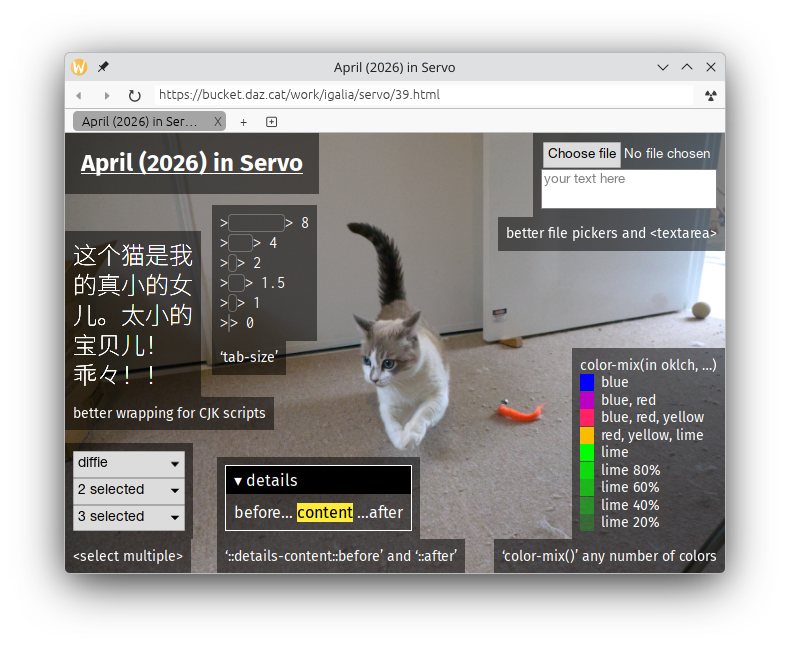
April in Servo…
📱🤖 revamped Android UI
☢️🗃️ IndexedDB now experimental
🌏✍️ better CJK text support
⏩ faster DOM tree mutations
🔬🪆 Scopes panel in DevTools

Sascha Foerster :bonndigital:
boosted


Sonntag findet der Tag der Artenvielfalt im Botanischen Garten statt. Super Event. https://www.botgart.uni-bonn.de/de/ihr-besuch/veranstaltungen/2026/tag-der-artenvielfalt


Even If You Hate AI, You Will Use Google AI Search
https://www.wired.com/story/even-if-you-hate-ai-you-will-use-google-ai-search/
https://app.flus.fr/links/1866009787195710476


Seafood is virtually all protein, that means in preparation it needs to be balanced with fat and carbs.
Hence the fried clam, God's perfect food.
André Hoarau
boosted


Aujourd’hui, c’est le dernier jour pour commander un #Quacken du lot de juin :
https://www.helloasso.com/associations/les-ergonautes/boutiques/quacken
Mais pas de précipitation : on refera un lot en décembre. 🙂


Here's a bit about the Kōkako.
https://www.nzbirdsonline.org.nz/species/north-island-kokako

Here's a view from the top, around 520m. A good bit of that ocean heading out from the shore is a marine reserve.