
The Untold Story About W Social: Unconventional Beginnings, Strategic Pitches and Conflicting Signals
I have been thinking a lot about the meteoric rise - out of nowhere - of a new player in the social media space: W Social, a platform soft-launched at Davos built on the promise of becoming the European answer to X. Earlier this month I published a long article about its surprise unveiling. And yet, I felt there was something missing from the story, worth examining.
W Social uncovered: the reality behind the hypeAn article dispelling myths about W Social, the new European platform that aims to rival X: it is a fork of Bluesky that shares many similarities with Eurosky and requires government ID to sign up. Elena RossiniElena Rossini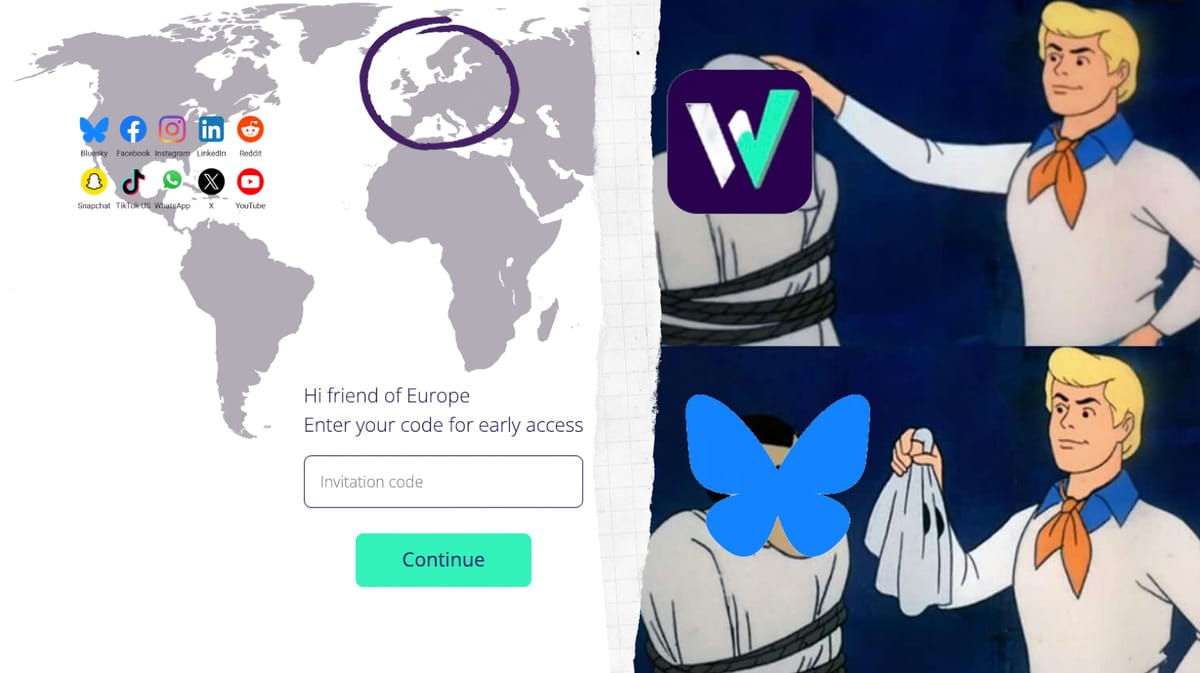
Everything about W Social is highly unusual. Had W Social been built on proprietary software - like BeReal, Monnett or Wedium - I would not have paid much attention to it.
What I found fascinating is that a group of C-level executives decided to launch a for-profit social media company built on an open-source protocol... without engaging with the open social web community, but working hurriedly on their own and then doing the surprise unveiling of their solution in Davos, during the World Economic Forum. If you're not familiar with the world of open source software let me say: a for-profit social platform using an open-source protocol that launches in Davos seems truly odd and incongruous... like a black flamingo. Thus my curiosity and desire to dig deeper.
Most media coverage about W Social has focused on rehashing their press releases and a few talking points; ironically nobody so far has covered the fundamental 5 Ws of news reporting - who, what, where, when and why - about W Social.
I’d like to present you a fascinating deep dive into the origin story of W Social, explore the strategic arguments they have been using to appeal to various groups (governments, media, advertisers and AI executives) and discuss conflicting signals.
⚠️Disclaimer:This article represents my personal opinions, commentary, and conclusions formed through independent research using publicly available sources. Any characterizations, interpretations, or inferences are presented as opinion, not as statements of objective fact. Readers are encouraged to review the referenced materials and draw their own conclusions.
The Untold Origin Story: W Social’s Unconventional Beginnings
Everything about W Social is different from your typical social media origin story. To begin, it runs on existing technology: ATproto, the open-source protocol powering Bluesky, which enables anyone to build and deploy their own fork; all its resources are available via a free MIT license:
GitHub - bluesky-social/atproto: Social networking technology created by BlueskySocial networking technology created by Bluesky. Contribute to bluesky-social/atproto development by creating an account on GitHub. GitHubbluesky-social
A foundational moment in the history of the company was... a Zoom call, set up in late October 2025 by Swedish entrepreneur Ingmar Rentzhog.
But let’s first rewind a few years - I promise all the information will be relevant later.
We Don't Have Time
Rentzhog created a foundation in 2017 called We Don’t Have Time, the majority stakeholder in a for-profit media company (“We Don’t Have Time AB”) whose purpose is to raise awareness about climate change.
We Don’t Have Time describes itself as “the world’s largest media platform for climate action, connecting everyone who is motivated to address the climate crisis.” Of note: the company also runs a social media platform, which, when it launched in 2018, aspired to become “the Facebook of climate change... a digital platform where anyone committed to solving the climate crisis can start a campaign, celebrate or criticize the actions of companies and politicians from a climate perspective and present suggestions and ideas.”
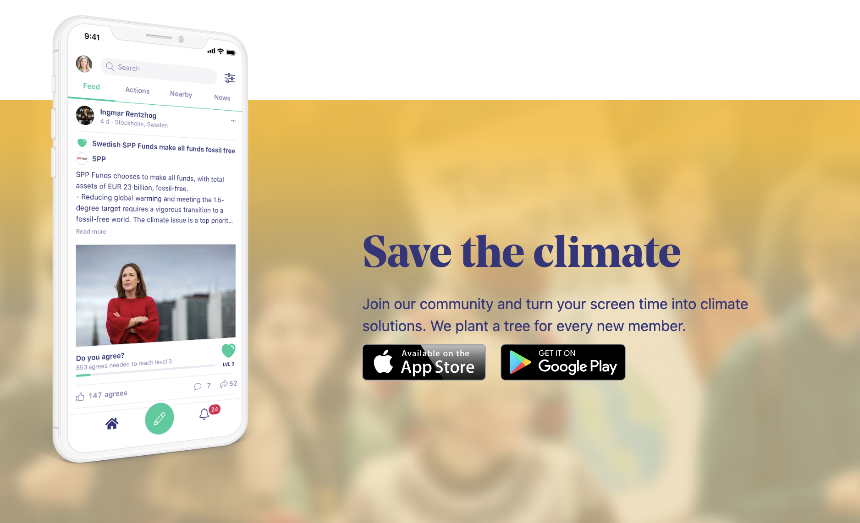 a screenshot of We Don't Have Time's website showing a section promoting their social media app, available on Apple's App Store and Google Play Store
I had never heard of We Don’t Have Time (the foundation, media company or social media network) before W Social made its surprising debut in Davos this past January.
Interestingly, the company is (infamously) mentioned in Greta Thunberg’s Wikipedia entry for a controversy regarding the young climate activist. Swedish newspaper Svenska Dagblatet wrote an exposé about this incident, stating:
Ingmar Rentzhog, an entrepreneur who claims he found and helped develop the Swedish climate activist Greta Thunberg into a world phenomenon, also used her name to bring in almost SEK 10 million in venture capital for his company - without her knowledge, SvD has found. “We had no information about that”, says Svante Thunberg, the teenager’s father.
Politico and The Local (Sweden) also covered this story.
At the time, Rentzhog denied the allegations and apologized for the "miscommunication."
Politico reported that in 2019 We Don't Have Time (a hybrid between a limited company and a charitable foundation) "raised 23 million krona (€2.2 million) in venture capital from more than 500 investors in 16 countries." Like many tech and media startups, the company isn't yet profitable and has relied on fundraising rounds to support its operations.
Well, W Social is another idea of Rentzhog’s.
Trendspotting
Why mention the Thunberg incident in an article about W Social? I'd venture to say that Rentzhog has a talent for spotting trends tied to societal causes - climate change, European digital sovereignty - and harnessing media attention to build businesses around them.
In a recent LinkedIn post to wish W Social CEO Anna Zeiter a happy birthday, Rentzhog shared the details of their fateful first meeting. Apparently Zeiter’s husband had been recommending that she and Rentzhog meet. As Rentzhog tells the story:
We postponed [the Zoom call] more times than I can count. Until October 31st, when we finally jumped on that Zoom call. [Zeiter’s husband] was right all along. From the very first minutes, Anna’s energy, clarity, and speed stood out. After 12 years at eBay, she needed just a few days to decide, and joined W Social AB as CEO, co-founder, and investor. That same weekend we spoke with our main investors. The following week, everything was signed.
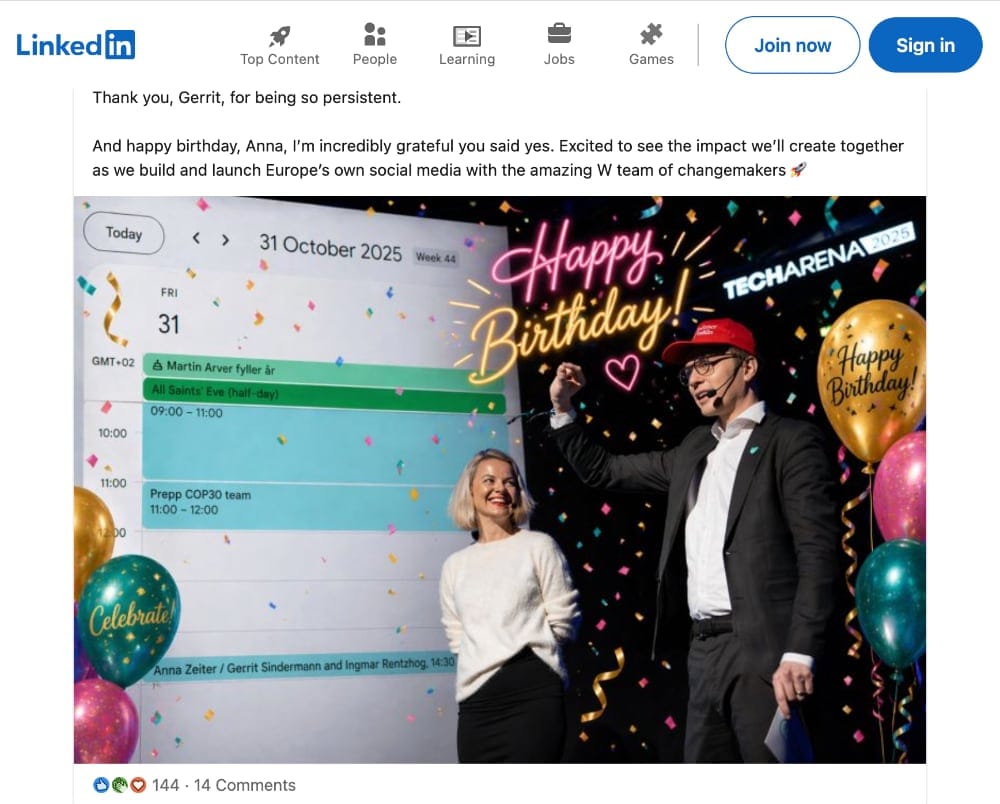
If you look at Swedish business database site allabolag.se, Anna Zeiter is listed as the executive director of W Social AB - a limited company - whereas Ingmar Rentzhog is the executive director of the sister company W Social & friends AB, whose purpose is to “own shares in W Social AB and related activities.” Both companies are headquartered at the offices of We Don’t Have Time in Stockholm, Sweden.
Zeiter has had a brilliant career so far as a C-level executive and a professor; she has established herself as a global expert in the field of data protection. Why was she the first pick of Ingmar Rentzhog for the role of CEO of W Social? Well, the company is positioning itself as the first major European social media platform to require identity verification. Under this angle, Zeiter provides expertise and reassurance to potential investors and would be users.
Things moved really quickly from that fateful first meeting.
W Social at Davos: First-Mover Advantage
Zeiter began working with the W Social team in November.
Only two and a half months later, W Social did a hurried "soft launch" at Davos during the World Economic Forum, organizing a private presentation and unveiling a rudimentary website - which took the open social web community by surprise.
(watch it on YouTube or Invidious)
Typically people working on projects based on the open protocols ActivityPub or ATproto build things in public, nurturing relationships with members of these communities, trading help and mingling at tech conferences like FOSDEM. Developers and champions of the open social web all know each other: this is a very small, highly collaborative, supportive community.
When W Social launched in Davos, nobody in this space had ever heard of Anna Zeiter or Ingmar Rentzhog. Even though the two co-founders had picked Bluesky's ATproto for their platform, they didn't even have accounts on the network; their social media platform of choice was LinkedIn (and We Don't Have Time for Rentzhog). By contrast, Elon Musk was a Twitter power user when he purchased the company in 2022. Rentzhog and Zeiter had their first accounts in the Atmosphere (the ATproto ecosystem) only when their developers created a personal data server for W Social; Rentzhog joined in February 2026 and Zeiter in March - weeks after the Davos launch.
This is precisely what made the unveiling of W Social so startling: it came out of nowhere. However there is a term in business - “first-mover advantage” - that describes the competitive edge one can gain by being perceived as the first player in a new market.
The W Social team took advantage of resources in Davos - the We Don’t Have Time video production team, professional contacts, journalists on site to cover the World Economic Forum - in order to get media coverage about their nascent venture and be perceived as an ideal solution for European digital sovereignty. The topic had been gaining momentum since the Summit on European Digital Sovereignty in November 2025.
As you may remember from my previous article, Eurosky - which had a similar pitch - was supposed to launch in January, too:
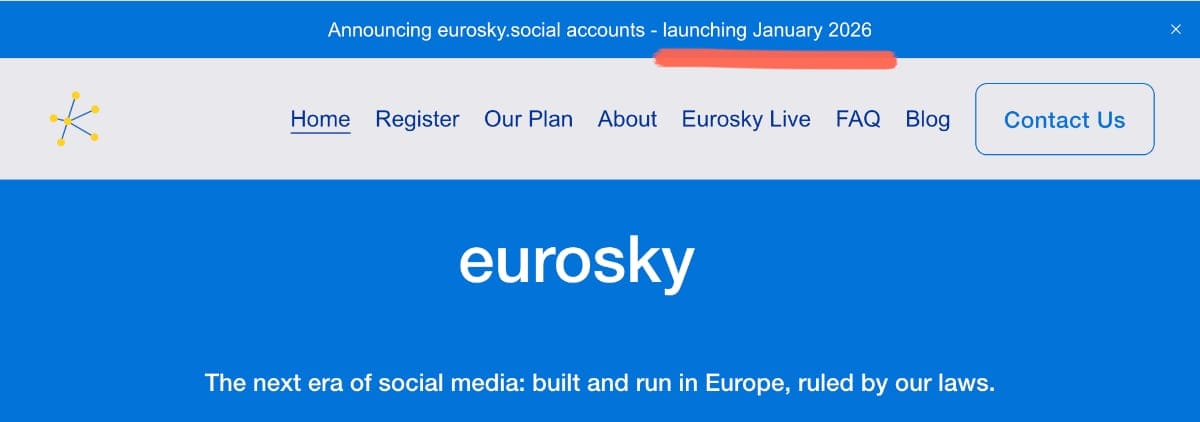 a screenshot of Eurosky's old homepage that said "launching January 2026" (highlight mine)
Whether the timing was intentional or not, W Social's "soft launch" in Davos garnered extensive media coverage across Europe. Eurosky - which had been in the works for months - wasn’t mentioned in any of the articles.
Most of the media coverage implied that W Social was an initiative backed by the European Commission; the first media organization to fact-check and correct this claim was Euronews, a full ten days after W Social’s soft launch. By then, an aura of respectability and institutional backing had settled around W Social, which could only have helped their fundraising and hiring operations.
Riding the wave of positive media attention, W Social began wooing politicians, advertisers and media companies with persuasive pitches tailor-made for each group.
W Social's Strategic, Ambitious Pitches
In the first weeks following the Davos unveiling, W Social's messaging was simple: they presented themselves as a European alternative to X, with data hosted on European servers and with the requirement to provide a form of government ID in order to create an account, so that they would have real users and not bots.
If you follow European politics, you would know that several EU member countries have been warming up to the idea of introducing social media bans for people under 16. Recently at a summit in Copenhagen European Commission President Ursula von der Leyen said: "The discussion about a minimum age for social media can no longer be ignored."
W Social was positioning itself as the first European social media platform with built-in age verification. This pitch worked well because it was simple and straightforward.
But then, in the ensuing weeks, W Social's arguments became increasingly more elaborate and ambitious, aspiring to "protect democracy," "bring back quality journalism," and keep 50 billion Euros of social media marketing on the continent – amongst other goals.
Wooing Politicians
In interviews with the press Zeiter often makes declarations about her desire to fight misinformation and “save democracy” via verified identities. The headline of Zeiter’s interview with Sweden’s Impact Loop stated: “My only political mission is to protect democracy”.
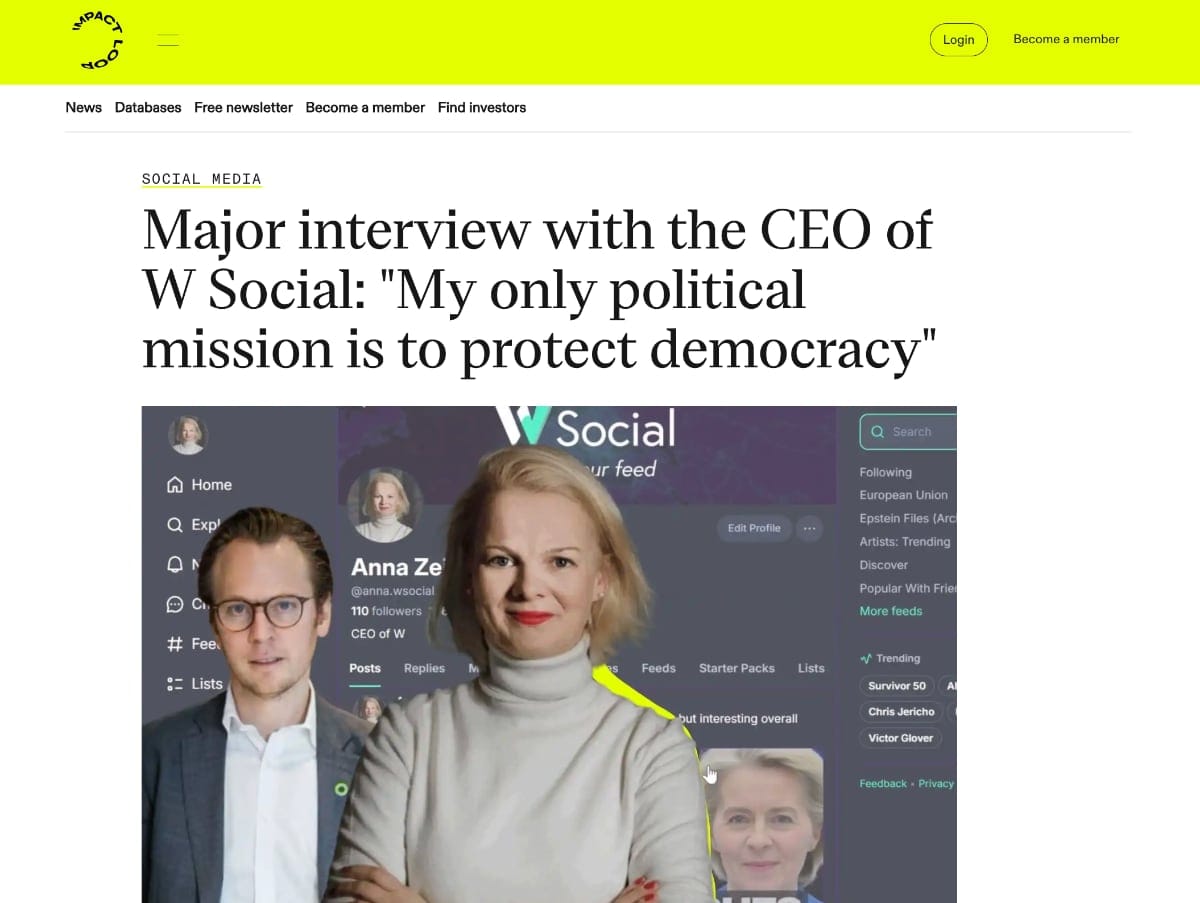
It’s fair to say that politicians across the political spectrum would welcome this message.
Wooing Journalists and Media Organizations
W Social has figured out a way to attract media organizations too: with the promise of micropayments, imitating the blueprint of Post.news, a now defunct microblogging platform that was created as an alternative to X.
In a recent interview during a webinar, W Social CEO Anna Zeiter shared that one of the missions of her social network is to “bring back quality journalism”:
We want to bring back quality journalism. We want to share also in the future the advertising revenue with them to make sure that they're thriving again. We are not extracting the value from quality journalism; we're actually giving back. And by this we want to create a platform where things like climate, environment can be discussed in a non-cancel culture. And I hope and I believe that this is a right approach for these times because at the end it's all about democracy and protecting democracy because democracy is protecting the truth. And if we have bot armies manipulating the public opinion it's very difficult to have honest and hard discussions in the online space.
(starting at 4:52 - watch it on YouTube or Invidious)
So: protecting democracy and saving journalism. Who would be against that?
An added perk of the plan to introduce micropayments and share advertising revenue with media organizations is that they would see W Social in a positive light - and this could potentially lead to favorable coverage. A win/win for everyone involved.
W Social Takes Its Mask Off
I had trouble reconciling all these lofty, virtuous goals with the brash way that W Social made its splash on the scene, without any attempts at collaborating with - or even acknowledging - existing players.
And then I stumbled upon a recent presentation by Zeiter at the conference Artificial Intelligence Monaco, held on May 2. After seeing how the W Social team adapted their pitch to appeal to politicians and media organizations, it was fascinating to watch a long, exhaustive presentation to a corporate audience with an interest in AI.
Zeiter said:
We want to protect democracy and the European market and we also want to keep the revenue of 50 billion Euros per year in Europe and don't want to give it away.
(starting at 7:31 – watch it on YouTube or Invidious)
The "50 billion Euros per year" bit referred to something Zeiter said earlier, claiming that "There is a social media market and the revenue is almost 50 billion Euros per year"... with that money going to US and Chinese social media companies. Zeiter possibly meant that social media ad spend in Europe is around 50 billion Euros and W Social would like to grab a slice of that pie.
Later, at 20:35 Zeiter said:
Yes we have a business model, it's not a philanthropy, we are not a B corp, we actually want to make money.
Finally, a candid statement about one of the motivations behind W Social: making money.
Anna Zeiter often mentions in interviews the quote: "Ten years ago we said 'data is the new oil,' right now we say 'high quality data is the new oil.'" With the presence of real humans - and not bots - W Social is positioning itself as a very attractive social media space for advertisers, with high quality data.
W Social’s Conflicting Signals
For a platform whose tagline is “Trust your feed," W Social’s communication strategy and narratives are filled with conflicting signals.
1) Contradictory Messages About W Identity and Data Retention
W Social’s most contested, talked about feature is its identity verification: the requirement to upload a valid piece of government ID in order to set up an account.
Zeiter has been emphasizing how seriously she takes the protection of personal data and has explained how there is a separate app for the verification of users’ IDs: W Identity, which uses a third party service - Neuro by Trust Anchor Group - to verify that a would-be user is (1) a real person (2) over the age of 18. When confirmed, the information is sent to the app W Social - then the personal data would be promptly deleted from their servers.
In an interview with Gavin Karlmeier for his Haken Dran podcast Zeiter said:
We just want to know that the people coming to us are human and over 18. It’s like an ID check at a club. Are you a human being, are you over 18? We don’t store the data afterward. We don’t want to build a government ID database. The less data a company has, the less data can be lost. And it’s not in my interest to store ID data, because that can only lead to us having a data breach at some point, which we definitely don’t want.
(starting at 52:46 – watch it on YouTube or Invidious)
During a presentation at ATmosphere Conference 2026 in Vancouver at the end of March, W Social developer Jan Lindblad explained the mechanics of W Identity and W Social, with a slide stating that W Identity locally (as in, on your own phone) "knows exactly who you are, but not which W Social account you have" whereas W Social - the platform - knows all about your social account "but not who you are."
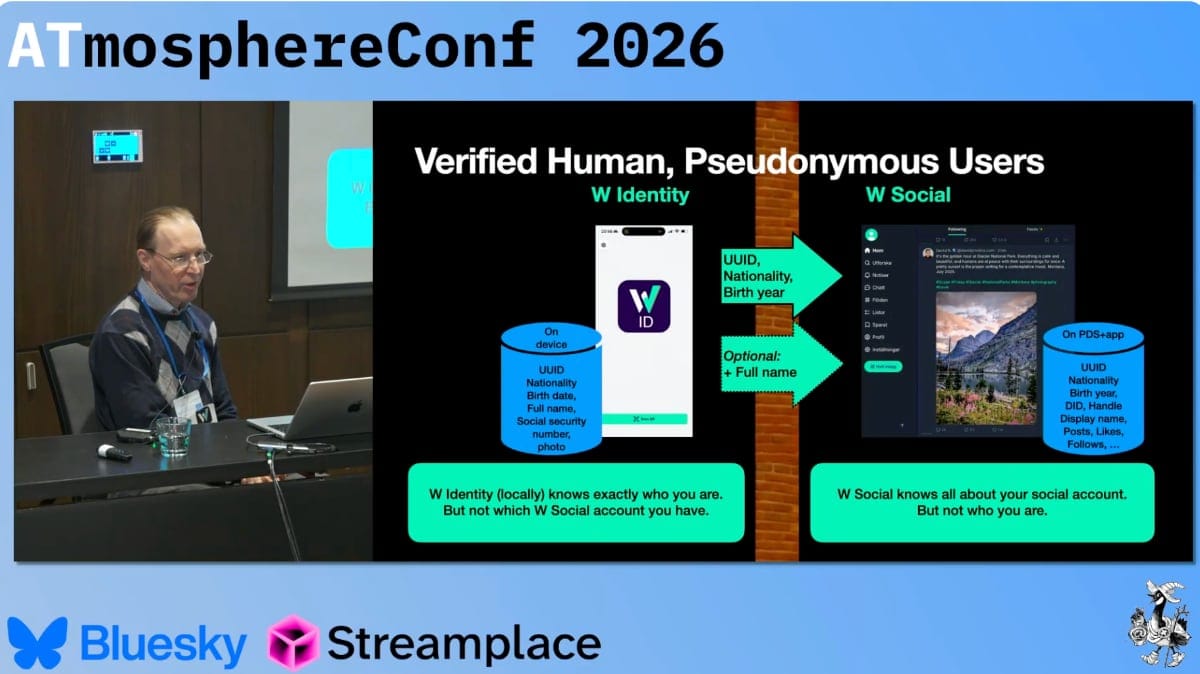 a slide from ATmosphere Conf explaining the inner workings of W Identity
If it is true that W Social never knows the real names of its users and government IDs are deleted within minutes after being verified, then what stops someone with ill intentions from registering multiple accounts, using different devices? Is there a hash string that is created to prevent this?
If W Identity has a mechanism in place to prevent duplicate sign-ups, then the app might store some identification data after all.
In addition to preventing multiple registrations, how will the site deal with impersonations?
I found it amusing that W Social CEO Anna Zeiter tagged Yariv Adan - an advisor to the company - in a post with the username he picked: @homersimpson@wsocial.eu.
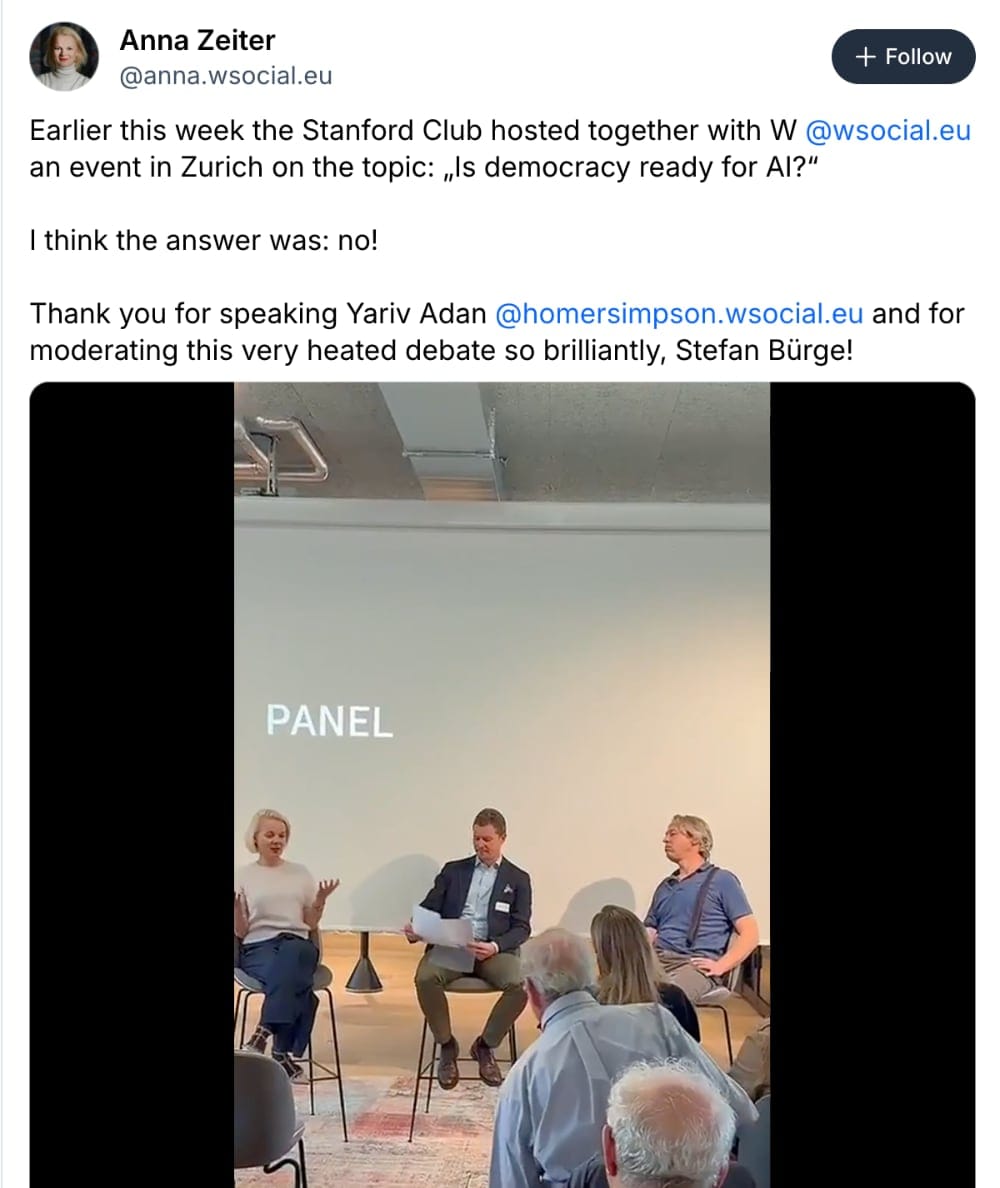 the screenshot of a post on W Social by Anna Zeiter where she mentions Yariv Adan who picked the username @homersimpson.wsocial.eu for his profile
If Adan was able to register as @homersimpson then someone could easily sign up as George Clooney - or worse, prominent government officials like Ursula von der Leyen or Emmanuel Macron.
How is W Social prepared to deal with impersonations, if a verified account can pick whichever username they choose?
2) W Social’s Emphasis on Verified Users… in an Open Network with Existing Accounts
After an initial failure to disclose that W Social was based on ATproto, its communications are now openly praising the protocol saying that an added advantage is that W Social's users can connect to a network with 40 million people.
Zeiter said to Table Media:
We are sitting on the ATprotocol, the same open source protocol as BlueSky. EuroSky is also sitting there. This means: we are already interoperable with 40 million users. Anyone who has a Bluesky account can follow me now.
In late April, European Climate Pact Ambassador for Germany Isabel Arens posted a message to the ATmosphere from her W Social account, saying: "GRATEFUL to be part of @wsocial.eu. Had to take a 📷 picture of the #onboarding with @hogiraslan.wsocial.eu and my excitement seeing European ☀️ solar panels on the feed! What was your first feeling opening #WSocial?" The photo accompanying the post showed the W logo at the top of the window, with two separate feeds: "Following" and "W Social Users". So, in this sneak peek of the platform one can see a distinction between posts by all members of Bluesky/ATproto and those by W Social users.
Isabel Arens (@isabel-arens.wsocial.eu)GRATEFUL to be part of @wsocial.eu Had to take a 📷 picture of the #onboarding with @hogiraslan.wsocial.eu and my excitment seeing European☀️solar pannels on the feed! What was your first feeling opening #WSocial? Bluesky SocialIsabel Arens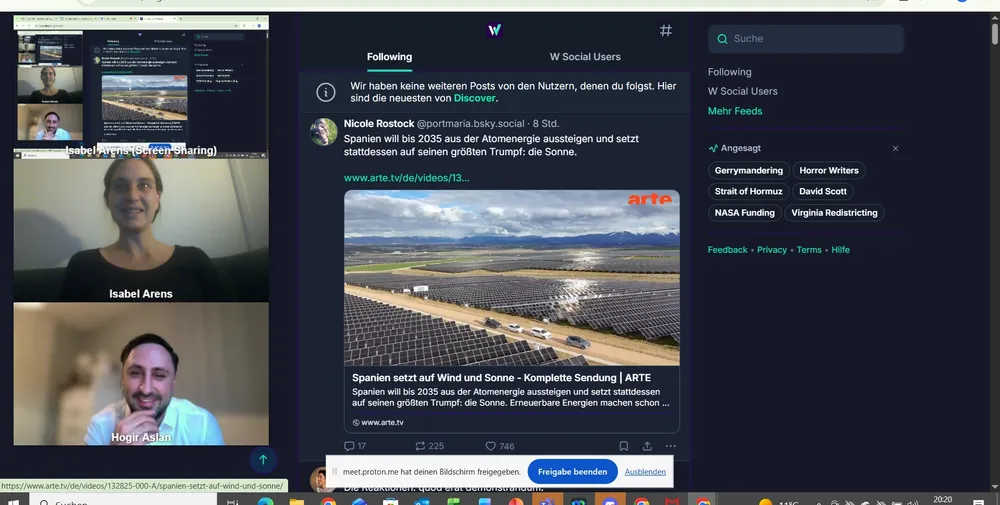
a sneak peek at the W social interface
The 40 million existing Bluesky / ATproto users are not verified by government IDs, so the main argument of building a network filled with ID-verified humans - not bots - to prevent the spread of misinformation and protect democracy is a bit… contradictory to say the least.
3) Protecting User Data or Using It to Train European AI Models?
In recent interviews with the press and podcasters, Zeiter has been emphasizing her commitment to protect users' data.
Yet, she mentioned something that would contradict that goal during her presentation at Monaco AI Conference 2026.
Remember her quote cited earlier that said "We want to protect democracy and the European market and we also want to keep the revenue of 50 billion Euros per year in Europe and don't want to give it away"? Well, here is what Zeiter said immediately after:
And we also want to keep European data in Europe to maybe train European AI models with our data because we also have amazing AI companies in Europe that we can support with this revenue and with that data.
(starting at 08:00 - watch it on YouTube or Invidious)
This statement struck me for two different reasons. First of all, if users publish posts on an open network built on ATproto, any company could easily find ways to scrape that data to train their AI models. It doesn't really matter that W Social's servers are based in Europe. Everything is public on Bluesky/ATproto: the information about when one joined, or moved their accounts, who one is blocking and is blocked by, lists, likes, posts. Everything.
More egregiously, Zeiter's statement shows a potential failure to understand the culture of Bluesky and the ATmosphere. Most users abhor the use of AI inside the platform for privacy and a plethora of other reasons. So much so that when Bluesky PBC announced the AI-powered feed assistant Attie at the aforementioned ATmosphere Conference in Vancouver, Attie quickly became the second most blocked account on Bluesky (after American vice president JD Vance).
Are W Social users aware of these plans to "maybe train European AI models with [their] data"?
Interestingly, W Social advisor Yariv Adan (@homersimpson@wsocial.eu) spent 17 years at Google building AI products: he co-founded Google Assistant and Google Lens and led the teams for Google Cloud’s Conversational AI and Applied GenAI.
Interview Of The Week: Yariv Adan, AI Expert - The InnovatorAI expert Yariv Adan, a former Google executive, discusses why AI is rewriting the basic rules of business. The InnovatorJennifer L. Schenker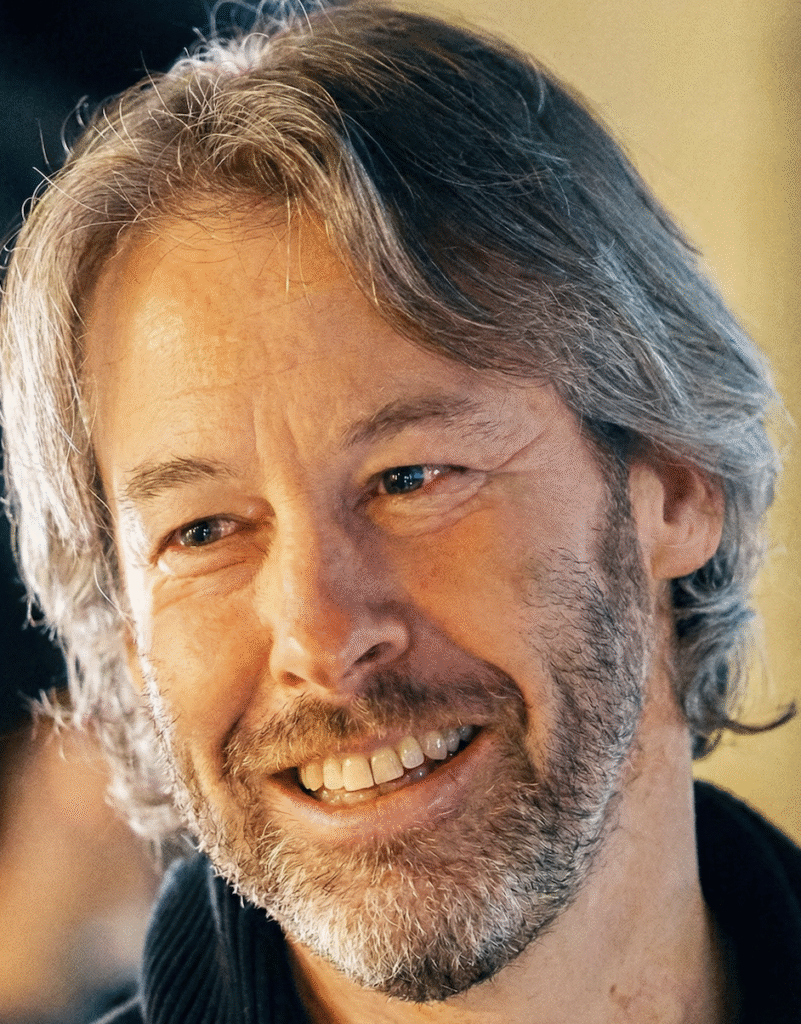
AI slop has been polluting the internet for the past three years. Is it possible that the promise to have a social platform with real human beings and not AI bots would make it attractive to AI companies who could train their data on fresh human content?
Only time will tell which direction W Social will take. For now, I think it's important to be wide-eyed and conscious about the profit motives behind their design and technical decisions.
Wrapping Up
My views about W Social have gone through a full cycle: initial dismissal about their potential (based on the poor quality of their launch website), then a reassessment after analyzing their various strategies… and now I’m back at the beginning, thinking it may have an uncertain future. Why?
The European Union is launching its own official age verification app later this year; micropayments didn’t manage to keep Post.news afloat and for contextual ads to turn a profit, W needs a large user base. Of course, just like We Don’t Have Time, W could carry on for years with private investments.
W Social's beta program will open on June 17th and it will be interesting to see how many people will be willing to give W their government IDs to set up an account - when Eurosky and Bluesky exist, plug into the same network, and do not have such a requirement.
Only time will tell. One thing is certain: open networks are the future of social media and Wedium, Monnett, eYou and Bulle (new European social platforms built on proprietary software) are on much shakier ground.
Thanks for being here,
Elena
P.S.: special thanks to h, LS and BW for their help

💓 Did you enjoy this post? Share it with a friend!
👫 Follow me on Mastodon. All my other links are available here: elena.social
💌 If you'd like to say hi, my contact information is here
✏️ If this post resonated with you, leave a comment!